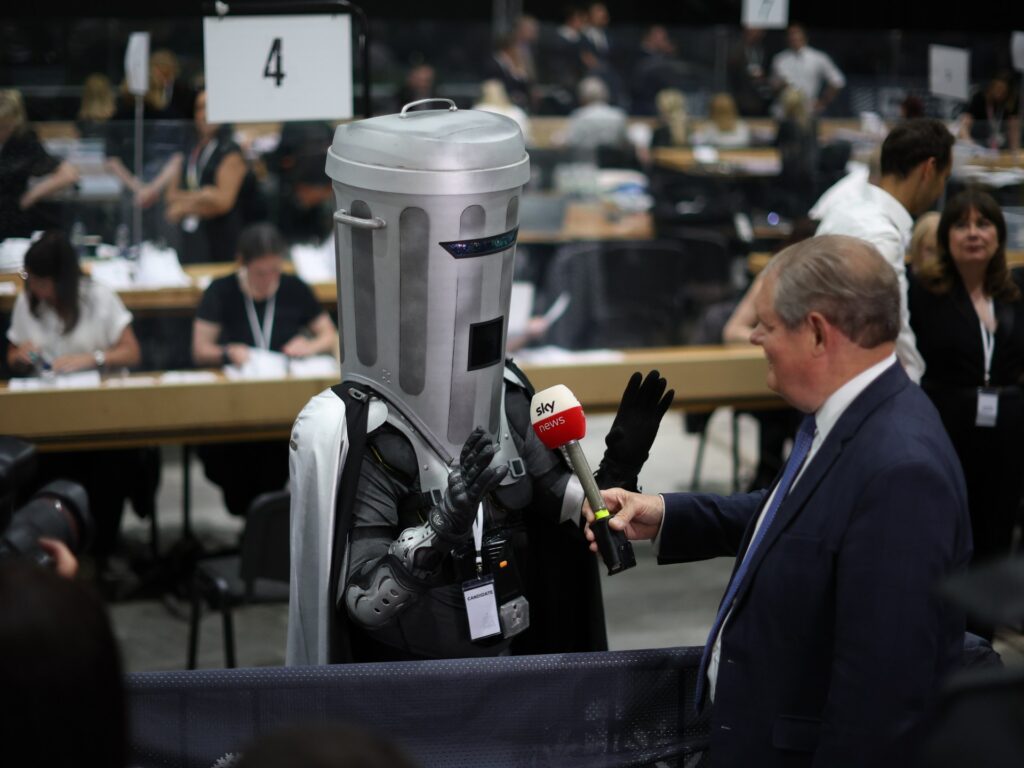
In the English constituency of Clacton, renowned for its association with former UKIP leader Nigel Farage, a unique and humorous contender has emerged as the only challenger to Farage’s bid to become MP once again. This candidate goes by the name Count Binface, recognizable for his quirky campaign style and his distinctive bin-shaped helmet.
Count Binface isn’t your typical politician. The character is a satirical creation, designed to bring humor and a fresh wave of irreverence to the often serious and contentious world of politics. His bin-shaped helmet is not just a costume; it’s a symbol meant to mock and highlight political issues with a comedic twist.
The choice of the name ‘Count Binface’ is a playful jab, combining elements of nobility and absurdity, which contrasts starkly with conventional political branding. This strategy has attracted attention and a devoted following among voters who are disillusioned with mainstream political candidates.
His presence on the ballot signifies a growing trend in UK politics where joke candidates engage voters differently. They often use satire to criticize political systems, raise awareness about various issues, and engage younger voters who might otherwise be disengaged from the electoral process.
Count Binface’s campaign touches on numerous issues, albeit presented in a humorous manner. His messaging attempts to cut through the noise of traditional political rhetoric, emphasizing that the political landscape could benefit from fresh perspectives and less conventional approaches.
In Clacton, a seat that has seen significant political shifts and attention due to Farage’s influence, Count Binface serves as a reminder that political contests can sometimes blend entertainment with representation. His candidacy challenges the seriousness of electoral politics by encouraging voters to question and think critically about their choices.
As the election approaches, Count Binface remains a singular opponent to Nigel Farage in Clacton, embodying the spirit of political satire and the enduring appeal of unconventional campaign strategies in British democracy. Whether or not he secures votes, his role as ‘Not Nigel Farage’ underscores the diverse and dynamic nature of political engagement in the UK today.