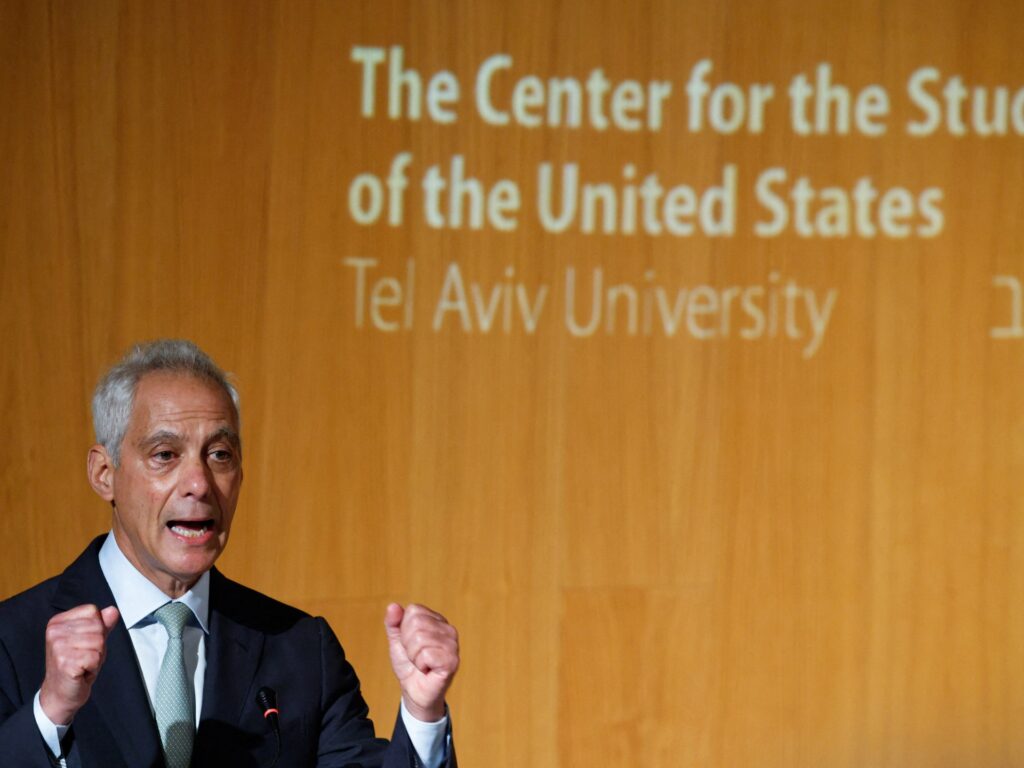
Rahm Emanuel, a prominent Democrat and former Obama administration official, has recently indicated a pivotal shift in the United States’ approach towards aid to Israel. Speaking publicly for the first time with presidential aspirations in mind, Emanuel urged Israel not to expect unconditional support from the U.S., marking a significant departure from the traditional bipartisan stance.
Emanuel’s remarks come at a time when the Democratic Party is reassessing its foreign policy strategies, particularly in the Middle East. His statement reflects a growing sentiment among Democrats that U.S. aid should come with considerations tied to broader geopolitical and human rights concerns rather than being guaranteed regardless of circumstances.
As a seasoned political strategist and former White House Chief of Staff under President Obama, Emanuel’s views carry weight in shaping the party’s platform. His potential run for president in 2028 could signal a new chapter in U.S.-Israel relations, emphasizing a more conditional and perhaps critical engagement.
Historically, U.S. support for Israel has been robust and largely unconditional, driven by strategic alliances, shared democratic values, and domestic political support for Israel in the United States. However, recent shifts within the Democratic Party suggest a trend toward scrutinizing the nature of this support more closely.
Emanuel’s call for a reassessment aligns with broader Democratic concerns about human rights issues and the necessity for Israel to engage in peace efforts that consider the rights and well-being of Palestinians. This approach might have implications for foreign aid packages, defense cooperation, and diplomatic engagement.
Critics of Emanuel’s stance argue that reducing unconditional aid could weaken Israel’s security and undermine a key U.S. ally in a volatile region. Supporters, however, see it as a necessary evolution of policy that holds partners accountable and promotes long-term stability and peace.
The implications of Emanuel’s comments also reach into domestic U.S. politics, where support for Israel has traditionally been a unifying issue. This new perspective could reshape voter bases and influence how both Democratic and Republican candidates approach foreign policy discussions related to the Middle East.
Emanuel’s speech is expected to resonate widely within the Democratic Party, which is increasingly attentive to progressive voices advocating for human rights and a reassessment of alliances based on ethical considerations.
This development underscores the dynamic nature of international relations and the impact domestic political shifts can have on longstanding foreign policies. Emanuel’s candidacy and his expressed views suggest that discussions around U.S.-Israel relations will be a critical topic in the upcoming presidential election cycles.
As the Middle East continues to face complex challenges, including conflict, humanitarian crises, and geopolitical shifts, the stance of influential U.S. politicians like Emanuel will be pivotal in shaping future American foreign policy.
Observers will be watching closely to see how Emanuel balances these international issues with his campaign ambitions and how his approach influences other Democratic contenders and the broader direction of the party.
In conclusion, Rahm Emanuel’s recent statements signal a transformative moment in U.S.-Israel relations, reflecting broader changes within the Democratic Party and setting the stage for a more conditional and scrutinized partnership moving forward. This shift could redefine America’s role in the Middle East and impact the political landscape as the 2028 presidential race begins to take shape.