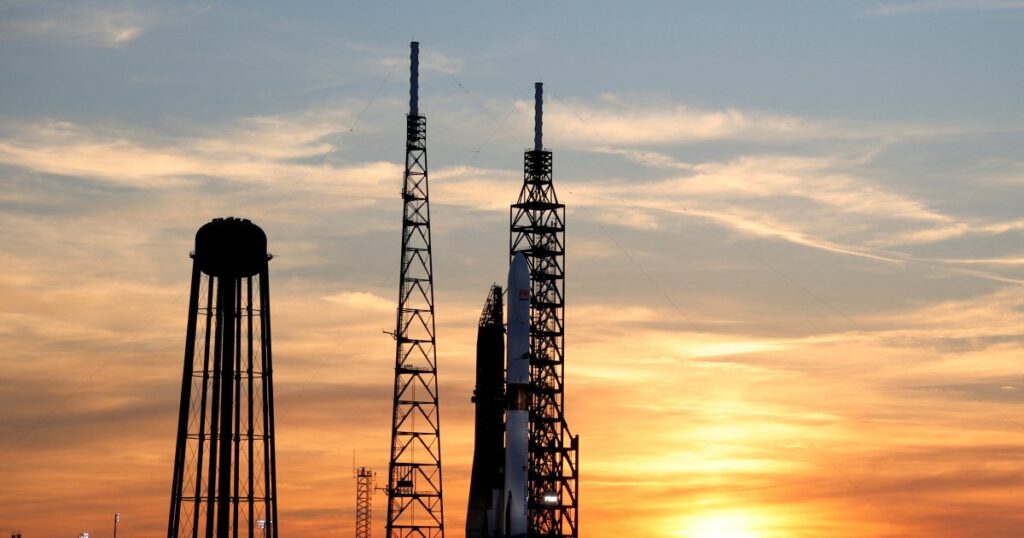
On a critical day for American space exploration, Blue Origin’s New Glenn rocket experienced a catastrophic failure, exploding on its launchpad in Florida. The incident marks a significant setback for Jeff Bezos’s ambitious space venture as it aims to close the technological and market gap with Elon Musk’s SpaceX, a dominant force in the aerospace industry.
The New Glenn rocket, named after John Glenn, the first American astronaut to orbit Earth, represents Blue Origin’s most ambitious project yet. Designed as a heavy-lift launch vehicle, New Glenn’s mission has been to provide reliable and cost-effective access to space for both commercial and government payloads. The rocket’s explosion shortly before or after ignition has raised concerns about potential technical faults and safety protocols.
This unfortunate event unfolds at a time when the space race is heating up, with private companies pushing the envelope of technology to win lucrative contracts and demonstrate innovation.
Jeff Bezos, the founder of Blue Origin and the world’s richest man, has invested heavily in space exploration. His vision includes making space travel more accessible and developing infrastructure that supports human life beyond Earth. However, the explosion of New Glenn underlines the challenges companies face in translating futuristic plans into reality.
Competing directly with SpaceX, Blue Origin has faced several hurdles. While SpaceX has successfully launched numerous Falcon rockets and recently made advancements with their Starship program, Blue Origin’s setbacks delay their progress toward similar milestones. The explosion not only damages the physical rocket but could also delay launch schedules, affect investor confidence, and disrupt strategic partnerships.
Moreover, the incident shines a spotlight on the intense competition in the private aerospace sector. SpaceX’s repeated successes have set a high bar for innovation and reliability. Blue Origin’s explosion could serve as a moment of reflection and an impetus for renewed focus on engineering excellence and testing rigor.
Industry experts suggest that such failures, while costly and disappointing, are part of the iterative process necessary for progress in space technology. The path to the stars is fraught with technical challenges that require resilience and adaptability.
Blue Origin has promised a thorough investigation into the cause of the explosion. Engineers and safety teams are expected to analyze data meticulously to understand what went wrong and prevent future occurrences.
The Florida launchpad itself suffered damage, necessitating repairs before any further launches can be attempted. This adds another layer of complexity to Blue Origin’s operational timeline.
Despite this setback, optimism remains high within Blue Origin and the broader aerospace community. The company has a track record of innovations and achievements in suborbital flight with its New Shepard program.
As the aerospace industry watches closely, the incident fuels a broader discussion about the risks and rewards of commercial spaceflight. It underscores that success in this frontier requires not only vision and capital but also an unyielding commitment to safety and detail.
In conclusion, the explosion of Blue Origin’s New Glenn rocket on the Florida launchpad is a dramatic reminder of the perils involved in pioneering new frontiers. It challenges Jeff Bezos’s space venture to overcome adversity, accelerate innovations, and reassert its role in shaping humanity’s future in space. The coming months will be pivotal as Blue Origin works to recover, rebuild, and launch again toward the stars.