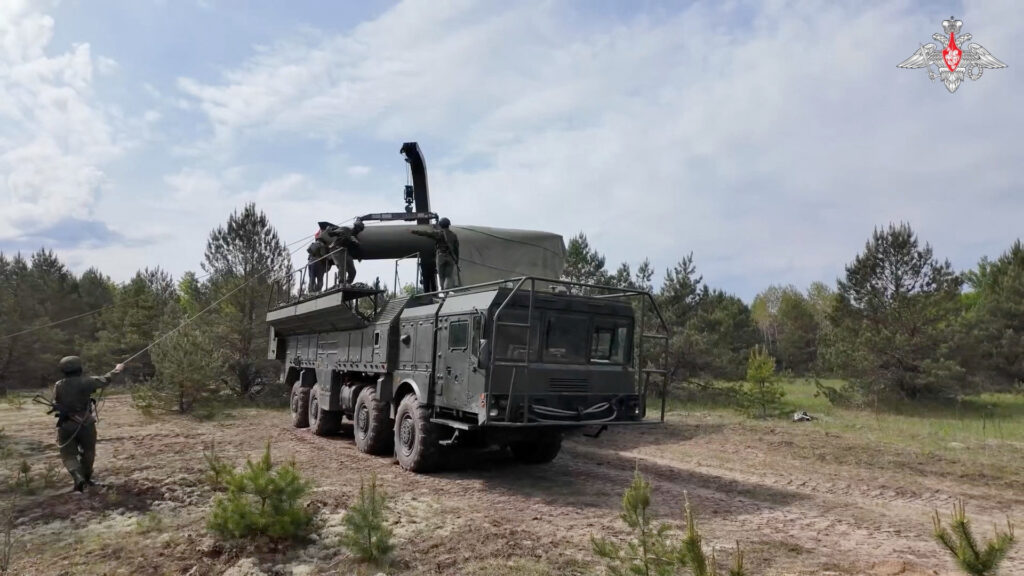
Service members mount a missile on a Russian Iskander-M missile launcher during nuclear forces exercises at an unidentified location in Belarus, in this still image taken from handout footage released on May 21, 2026. Russian Defence Ministry/Handout via REUTERS ATTENTION EDITORS - THIS IMAGE WAS PROVIDED BY A THIRD PARTY. NO RESALES. NO ARCHIVES. MANDATORY CREDIT. WATERMARK FROM SOURCE.
Russia has recently carried out a significant military exercise with Belarus, which included rehearsals involving the use of nuclear forces. As part of these three-day drills, Russia delivered nuclear warheads to designated sites within Belarusian territory. This move underscores the increasing military cooperation between the two countries and highlights the strategic significance of their alliance. The joint exercises aimed to enhance the readiness and coordination of their nuclear forces in the context of regional security challenges.
The drills involved multiple aspects of military operations, focusing particularly on the deployment and potential use of nuclear warheads. Russian forces transported the warheads to Belarusian military sites, simulating scenarios that test the command and control mechanisms, as well as the rapid deployment capabilities of their nuclear arsenal. This demonstration of strength signals a message of deterrence amid ongoing geopolitical tensions.
Belarus, a close ally of Russia, has been integrated into these exercises to showcase joint operational capabilities and mutual defense commitments. The collaboration also serves to reinforce the presence of Russian nuclear weapons in Belarus, a development that has drawn international scrutiny and concern due to the escalation of military posturing in Eastern Europe.
The drills are reported to have included strategic missile forces, airborne units, and electronic warfare components, illustrating the multi-dimensional nature of modern military conflicts. Both countries coordinated their forces to improve interoperability and response times, critical factors in nuclear deterrence strategies.
In response to these developments, Western governments and NATO allies have expressed apprehension about the increasing assertiveness of Russian military activities in the region. The presence of nuclear warheads outside of Russia’s borders is seen as a provocative act, potentially destabilizing the existing balance of power.
Experts note that such exercises serve dual purposes: deterring external threats and reinforcing alliances. The rehearsal of nuclear force application helps ensure that command structures remain effective in high-pressure scenarios, thereby maintaining credible deterrence.
The exercise also marks a significant evolution in Belarus’ military posture, as the country assumes a more active role in housing nuclear capabilities. This could signal a shift in regional security dynamics, potentially prompting neighboring countries to reevaluate their defense strategies.
Overall, the three-day military drill reflects an intensification of military ties between Russia and Belarus, with a pronounced emphasis on nuclear readiness and strategic coordination. The implications of this exercise resonate beyond the immediate region, contributing to the complex security environment in Europe and affecting global discussions on nuclear arms control and military alliances.