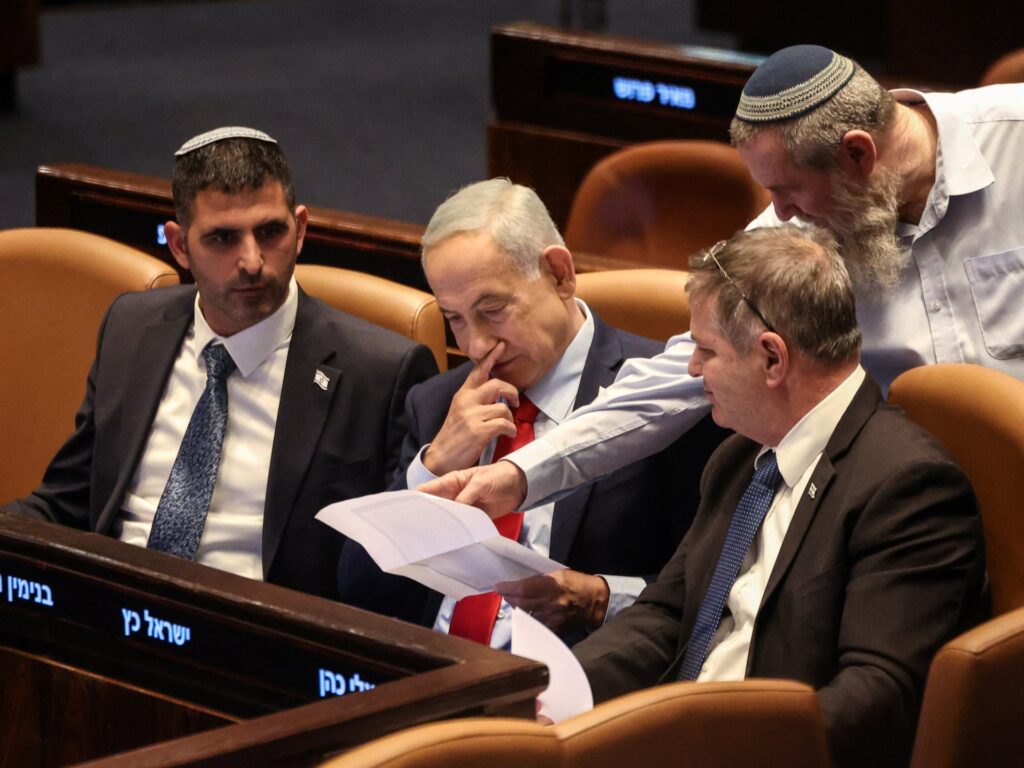
In a significant political development, Israeli lawmakers have advanced a bill aimed at dissolving the parliament, intensifying the ongoing political turmoil in the country. The move comes as Prime Minister Benjamin Netanyahu faces mounting pressure within his fractious right-wing coalition. This coalition, characterized by internal disagreements and fragile alliances, has taken the unprecedented step of submitting the bill that would trigger new elections and effectively dissolve the current legislative body.
The bill’s advancement marks a pivotal moment in Israeli politics, reflecting the deep divisions and instability that have plagued Netanyahu’s government. With the prospect of the parliament being dissolved, the legislative agenda faces uncertainty, and the government’s ability to govern effectively is called into question.
Netanyahu’s political future hangs in the balance as his coalition partners grow increasingly restless. The right-wing bloc, which has supported his leadership, is now fragmented, with some members advocating for a fresh mandate from the electorate. The dissolution bill is seen as a tactical move to reset the political landscape and possibly secure a stronger majority in upcoming elections.
The Israeli public watches closely as the political drama unfolds, aware that the dissolution of parliament could lead to significant changes in the government and its policies. The call for new elections offers both an opportunity for political renewal and a period of uncertainty that may impact Israel’s domestic and foreign affairs.
Analysts suggest that the bill’s passage reflects broader regional dynamics and internal political pressures that have intensified over recent years. Netanyahu’s tenure has been marked by both achievements and controversies, and the push to dissolve parliament underscores the challenges he now faces in maintaining a cohesive government.
The coalition’s decision to submit the bill signals a critical juncture in Israel’s democratic process. If the bill passes, it will initiate a countdown to new elections, prompting various political factions to prepare their campaigns and strategies. This period will likely be characterized by heightened political activity and public debate about the country’s direction.
Observers note that while the dissolution of parliament is a democratic mechanism designed to resolve political deadlocks, it also exposes fault lines within the government that could have longer-term implications. The outcome of this political maneuvering will be closely watched both domestically and internationally, as Israel plays a strategic role in the Middle East.
In conclusion, the advancement of the bill to dissolve the Israeli parliament amid growing pressure on Prime Minister Netanyahu highlights the complexities of governance in a divided political landscape. As the situation evolves, all eyes remain on Israel, awaiting the next chapter in its ongoing political saga.