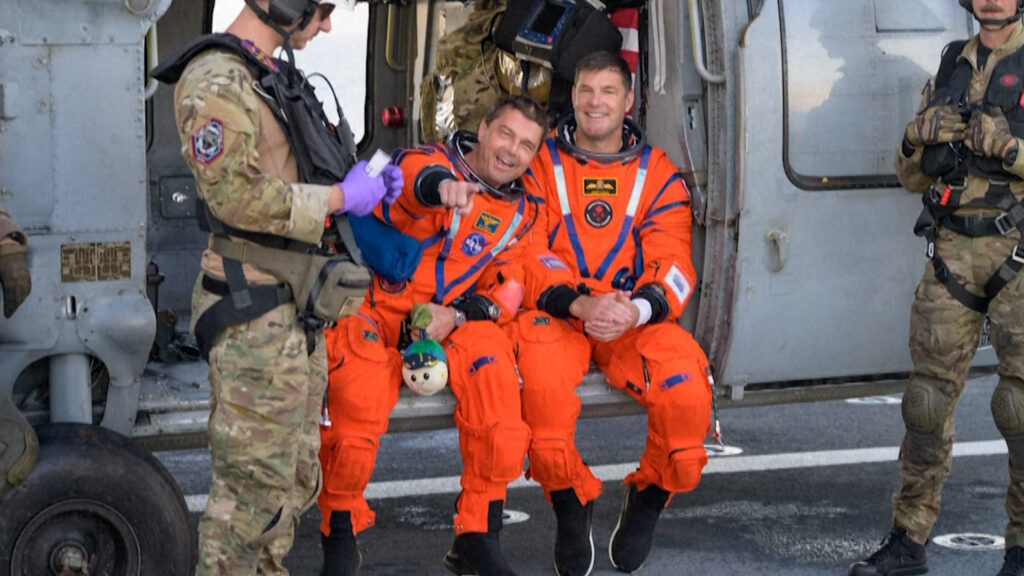
NASA’s Artemis II mission marked a significant milestone in human space exploration as its crew was safely retrieved by a US Navy recovery ship upon their return from a lunar mission. The Artemis II astronauts were photographed being carefully supported across the deck of the recovery vessel, highlighting the well-coordinated efforts made to ensure the crew’s health and safety after their journey beyond Earth’s orbit.
The Artemis II mission followed the successful Artemis I uncrewed test flight, aiming to further validate the capabilities of NASA’s Space Launch System (SLS) and Orion spacecraft for manned lunar expeditions. This mission was the first to carry astronauts around the Moon since the Apollo program, rekindling humanity’s goal of sustained presence on the lunar surface.
After orbiting the Moon and performing critical trajectory and systems checks, the crew’s capsule splashed down in the ocean, where the US Navy recovery ship was dispatched to retrieve the astronauts promptly. Specialized personnel on the recovery ship assisted the astronauts in exiting the capsule, providing necessary medical evaluations and support as they were transferred onto the ship’s deck.
The seamless recovery operation involved extensive planning and coordination between NASA and the US Navy, reflecting lessons learned from past spaceflights and advancements in recovery technology. Such collaborative efforts are crucial for the future Artemis missions, which aim to establish a sustainable human presence on the Moon and prepare for eventual voyages to Mars.
Public and media attention surrounding the Artemis II crew highlighted the human aspect of space exploration—the astronauts’ health, resilience, and the rigorous preparations required for deep space travel. NASA’s commitment to astronaut safety during all mission phases demonstrates the agency’s dedication to pioneering exploration while safeguarding its human crews.
The successful Artemis II mission not only advances technological and scientific objectives but also represents a renewed commitment to international cooperation in space endeavors. As NASA looks forward to Artemis III, which plans to land astronauts on the lunar surface, the recovery of Artemis II sets a robust precedent for future mission safety protocols.
Ultimately, seeing the Artemis II crew safely assisted on the recovery ship’s deck serves as a powerful visual testament to the culmination of years of hard work, determination, and innovation that propel human spaceflight into a new era of exploration beyond Earth.