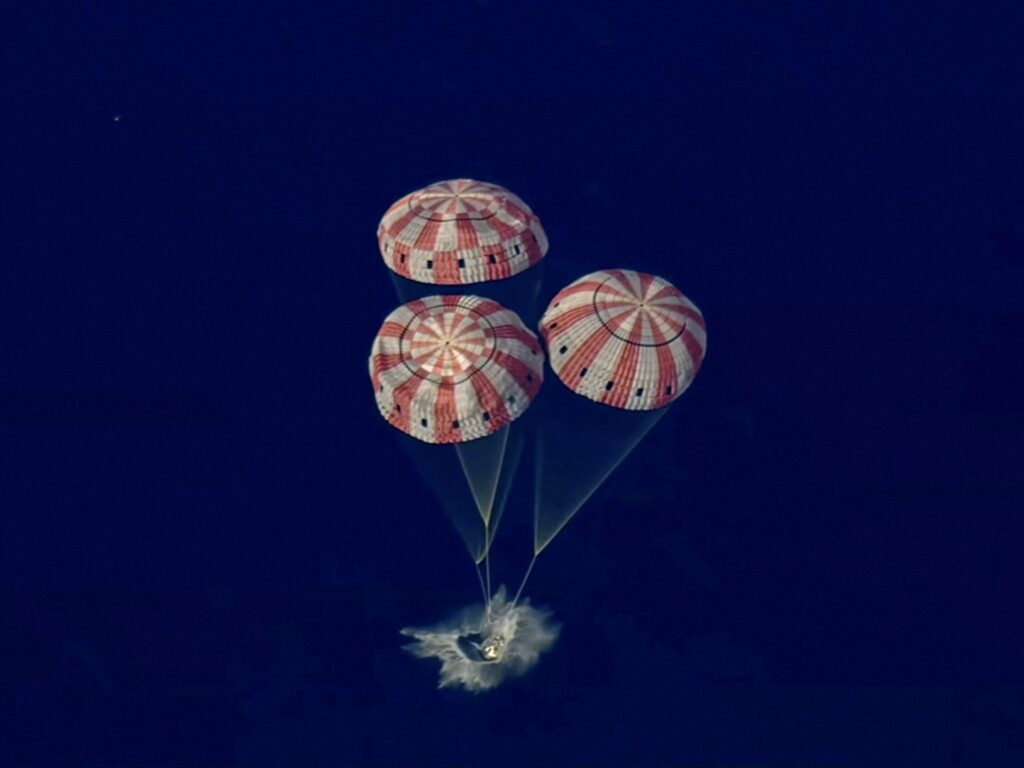
In a momentous occasion for space exploration, NASA’s Artemis II mission has successfully splashed down on Earth, marking the completion of a landmark journey to lunar orbit. The Artemis II crew, consisting of four astronauts, returned safely after circumnavigating the Moon, paving the way for future deep space missions and setting the stage for humanity’s return to the lunar surface.
The Artemis II mission, part of NASA’s broader Artemis program, represents a crucial second step in the agency’s goal to establish a sustainable human presence on the Moon and prepare for eventual manned missions to Mars. Unlike its predecessor Artemis I, which was an uncrewed test flight, Artemis II carried astronauts aboard the Orion spacecraft to perform critical maneuvers and system checks in lunar orbit.
Launched atop the powerful Space Launch System (SLS) rocket, Artemis II successfully completed its journey beyond Earth’s orbit, spending several days orbiting the Moon. During the mission, astronauts conducted experiments, tested life support systems, and validated spacecraft performance under deep space conditions.
The safe splashdown of the Orion capsule in the Atlantic Ocean marks a significant milestone for NASA’s human spaceflight ambitions. Recovery teams promptly retrieved the crew and spacecraft, signaling the end of an intense and meticulously planned mission timeline.
NASA Administrator praised the success of Artemis II, emphasizing the collaborative effort involving thousands of engineers, scientists, and mission controllers. The mission demonstrated the reliability of new technologies and underscored the agency’s commitment to pushing the frontiers of human space exploration.
Artemis II’s achievement carries profound scientific and symbolic significance. It revives the excitement and dedication reminiscent of the Apollo era while applying 21st-century technology to explore frontiers beyond low Earth orbit.
Looking forward, Artemis III is anticipated to build upon Artemis II’s success by landing astronauts on the Moon’s surface, including the first woman and the next man, as early as the mid-2020s. The Artemis program’s ambitious vision aims to enable sustained human exploration and eventual colonization of extraterrestrial environments.
The mission’s success also reinforces international cooperation, with several global space agencies contributing to various aspects of the Artemis program. This unity highlights a collective human endeavor to explore and understand space for peaceful and scientific purposes.
As the Artemis II astronauts reacclimate to Earth’s environment, NASA and its partners are already gearing up for the next missions, continuing humanity’s quest to unlock the secrets of the Moon and expand our presence in the solar system. The moment Artemis II splashes down is not just a return; it is the dawn of a new era in space exploration.