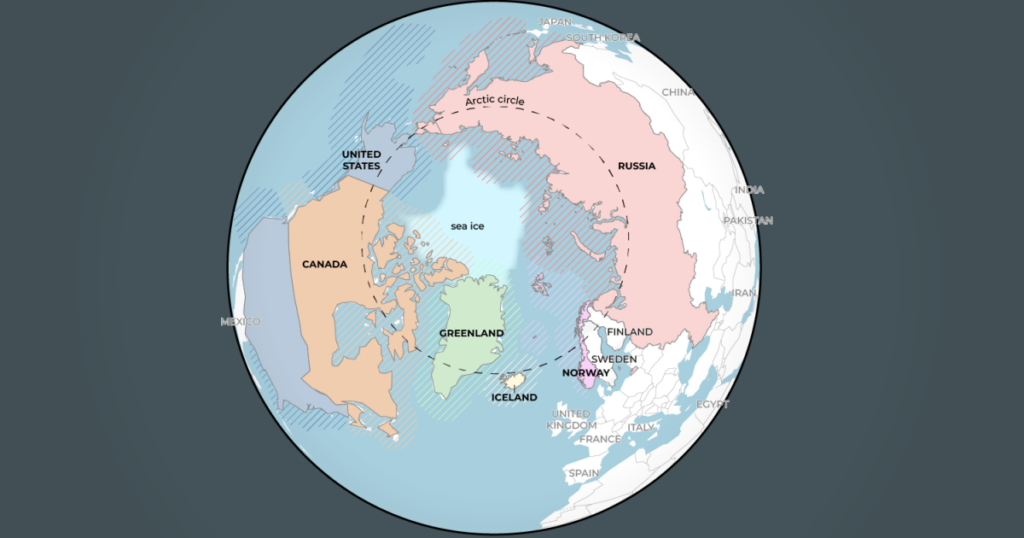
Greenland, the world’s largest island, holds a significant place on the geopolitical and economic map due to its unique location and abundant natural resources. Situated within the Arctic Circle, it is surrounded by the Arctic and Atlantic Oceans, placing it at a critical intersection between North America and Europe. This positioning has made Greenland a focal point of interest for global superpowers, including the United States under the Trump administration.
Covering over 2.1 million square kilometers, Greenland is mostly covered by an ice sheet, but its vast ice reserves mask a treasure trove of minerals and potential energy resources beneath. The melting ice due to climate change is making these resources more accessible, adding to the island’s economic significance.
Strategically, Greenland sits close to the northern routes that are becoming more navigable as Arctic ice recedes. These routes provide shorter paths for trade and military movements between the Atlantic and Pacific Oceans. Control over Greenland means control over these emerging Arctic shipping lanes, which could revolutionize global trade routes.
The island’s proximity to the North American mainland also offers military advantages. It is within striking distance of major U.S. territories and serves as a potential site for radar stations and missile defense systems, enhancing U.S. national security capabilities against emerging threats from countries like Russia and China.
The seven maps illustrating Greenland’s strategic importance highlight the growth of Arctic shipping routes, the locations of natural resources such as rare earth minerals and oil reserves, and the military installations in the region. These maps also show the island’s closeness to major global capitals, underscoring its strategic value on a geopolitical level.
In economic terms, Greenland’s untapped mineral wealth could prove crucial for industries worldwide, especially in technology sectors that rely on rare earth elements for manufacturing electronics, renewable energy components, and defense technologies.
Politically, Greenland holds a degree of autonomy from Denmark but is not fully independent. This unique status complicates ownership claims and global interest in the island. The Trump administration’s expressed interest in purchasing Greenland underscored the island’s value and the strategic considerations at play.
In summary, Greenland’s importance is multifaceted: it embodies a critical geographic foothold in the Arctic, offers substantial economic potential through its natural resources, and possesses considerable military value. These factors combined explain why the island has drawn unprecedented attention from global powers and why it remains a central topic in discussions about the future of the Arctic region and global geopolitics.