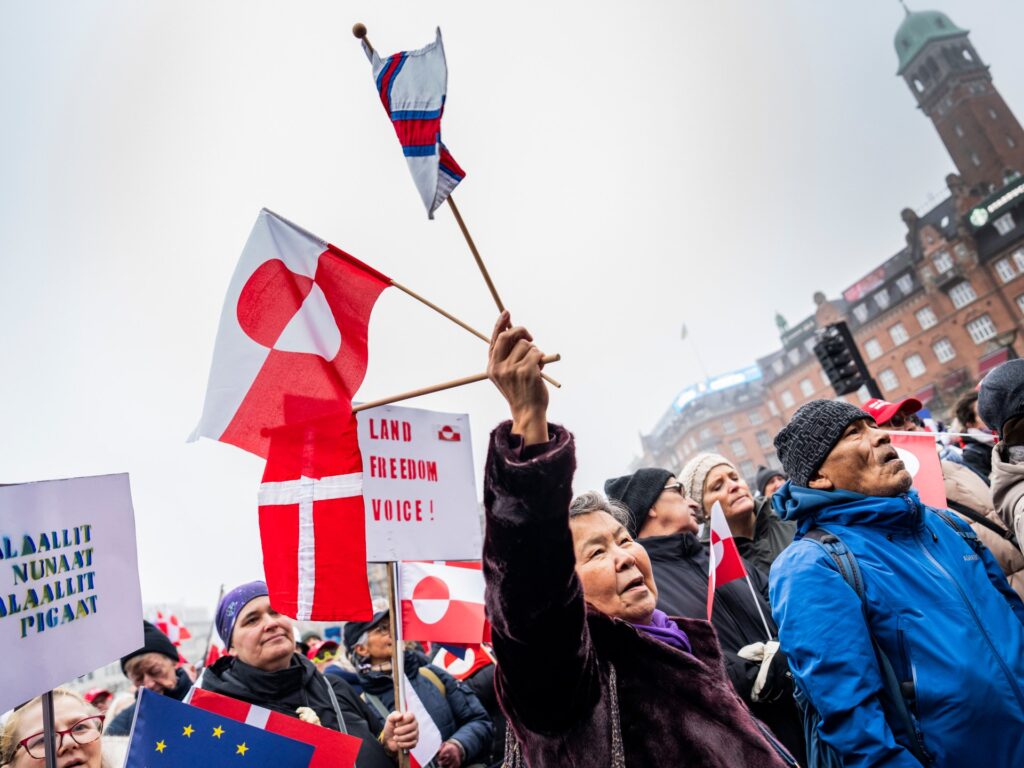
Thousands of protesters gathered in Copenhagen and other cities to rally against former U.S. President Donald Trump’s controversial threats to purchase Greenland. The self-governing Danish island, rich in natural resources and strategically located in the Arctic, has become the center of international attention. Protest organizer Jens Rasmussen emphasized that the “world must wake up” to defend Greenland’s autonomy and respect for the Danish government’s sovereignty.
The protests come in response to Donald Trump’s statements that the United States should consider buying Greenland, which Denmark rejected firmly. Greenland, with a population of around 56,000, enjoys broad autonomy under the relationship with Denmark, managing its internal affairs independently while Denmark oversees defense and foreign policy.
The idea of a U.S. acquisition alarmed many Greenlanders and Danes alike. Protesters expressed deep concerns over threats to their self-governance, cultural identity, and control over natural resources. The movement “Hands off Greenland” quickly gained momentum, drawing attention from the global community.
Several speakers at the Copenhagen rally condemned what they described as neocolonial ambitions. They highlighted the potential environmental risks and geopolitical tensions that could arise from an American takeover of the island. Greenland’s location is crucial to Arctic geopolitics, with rising interest from powers like China and Russia already causing strategic competition.
Experts argue that Greenland’s natural resources, including vast reserves of rare earth minerals and potential oil deposits, increase its geopolitical importance. Control over these resources could shift global power dynamics and raise environmental concerns.
The Danish Prime Minister reiterated Denmark’s commitment to Greenland’s autonomy and dismissed any proposals to sell the territory. The government expressed solidarity with protesters defending Greenland’s future.
Cultural leaders from Greenland also voiced their opposition, emphasizing Greenland’s unique heritage and the need to protect its environment against external exploitation.
The protests demonstrate rising awareness about indigenous rights and sovereignty amid global power contests in the Arctic region. They also signal a broader pushback against perceived threats to small nations’ autonomy from larger powers exploring territorial ambitions.
As tensions simmer, international observers call for dialogue and respect for sovereignty to maintain peace and stability in the Arctic. The ‘‘Hands off Greenland’’ movement symbolizes a united stand for self-determination and environmental stewardship.
In conclusion, the thousands who took to the streets in Copenhagen and beyond sent a powerful message: Greenland is not for sale, and its people’s rights and futures must be respected. The global community faces a crucial moment to uphold principles of sovereignty and environmental responsibility amidst increasing geopolitical competition in the High North.