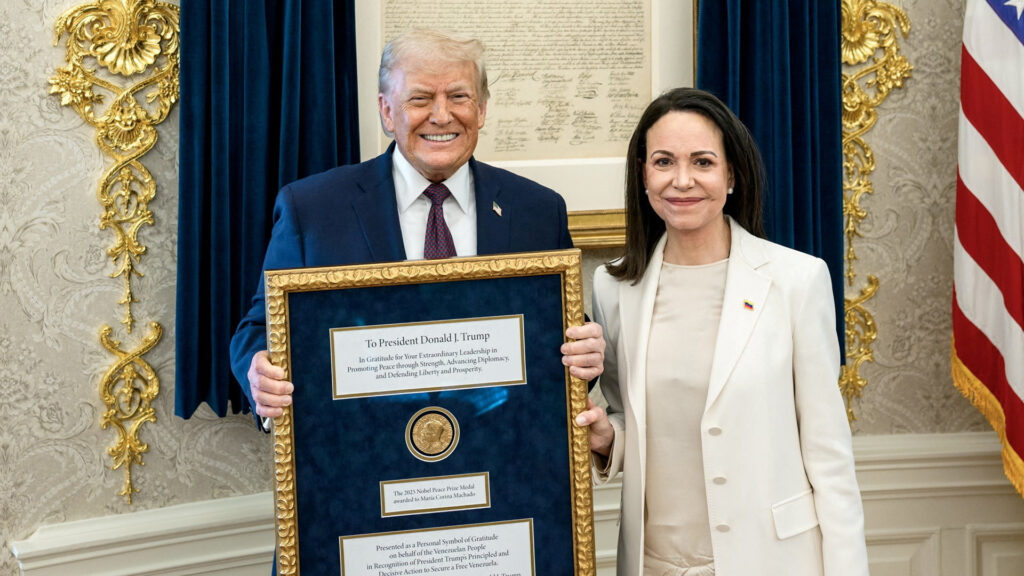
In a surprising and widely discussed event, Venezuela’s opposition leader María Corina Machado has presented former U.S. President Donald Trump with the Nobel Peace Prize. The White House released a photograph depicting the moment Machado handed the prize to Trump, sparking significant global attention and debate.
María Corina Machado, known for her staunch opposition to the Venezuelan government, has been a prominent figure in the country’s political opposition, advocating for democracy and human rights in Venezuela. Her gesture to confer the Nobel Peace Prize to Trump was unexpected, as the official Nobel Committee has not announced such an award to the former U.S. president.
The photograph unveiled by the White House shows Machado smiling as she hands what appears to be a Nobel Peace Prize award to Donald Trump, who received it with a characteristic expression. This image has quickly circulated in media worldwide, fueling discussions regarding its authenticity and the motives behind the ceremony.
It is important to note that the Nobel Peace Prize is officially awarded by the Norwegian Nobel Committee, an independent body that evaluates candidates based on efforts to promote peace and resolve conflicts globally. To date, Donald Trump has not been officially declared a laureate by the Nobel Committee.
Machado’s decision to present the prize in an informal or symbolic capacity underscores her admiration for Trump’s policies and actions, particularly in relation to his administration’s stance on Venezuela and its opposition to the Maduro regime. Trump’s government was known for imposing sanctions and taking a strong position against the Venezuelan government amid ongoing political and humanitarian crises.
The act has been met with mixed reactions. Supporters view it as recognition of Trump’s contributions toward promoting regime change and supporting Venezuelan democracy. Critics, however, argue the move undermines the prestige of the Nobel Peace Prize and question the message it sends about peace and diplomacy.
Political analysts suggest that Machado’s gesture serves to strengthen ties between her movement and Trump’s political base. It also highlights the complex nature of international recognitions where political narratives influence symbolic awards.
International observers are calling for clarity from the Nobel Committee regarding the authenticity of the award and emphasizing the importance of preserving the integrity of the Nobel Peace Prize as a symbol of genuine peace efforts worldwide.
This unusual instance raises broader questions about the politicization of prestigious awards and the role that political leaders play in shaping perceptions through public gestures, particularly in a polarized global environment.
As this story develops, more details may emerge clarifying the context and implications of María Corina Machado’s presentation of the Nobel Peace Prize to Donald Trump, a moment that will remain a curious episode in the intersection of politics and international recognition.