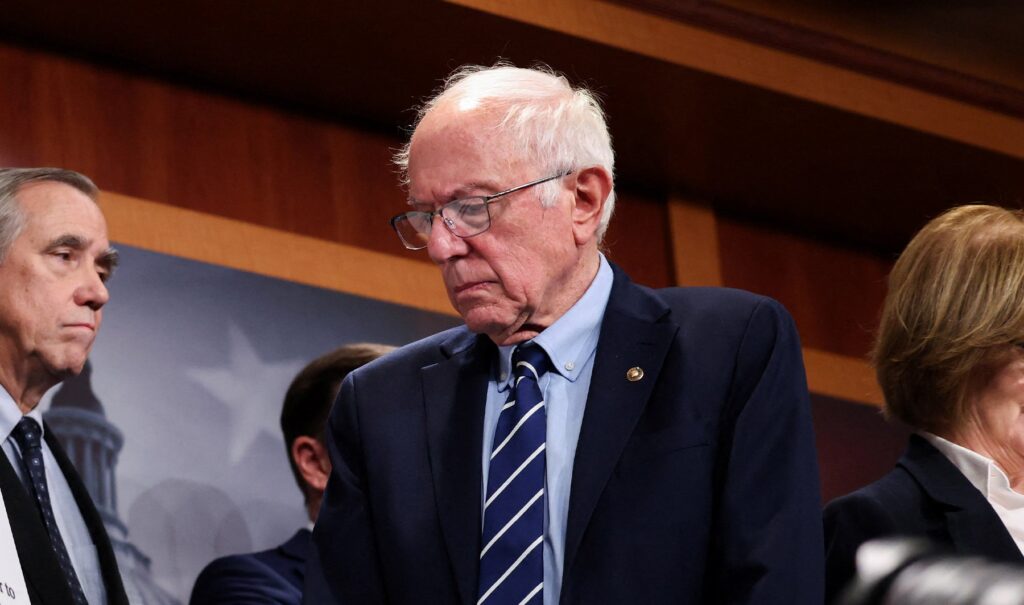
Senator Bernie Sanders has issued a forceful condemnation of former President Donald Trump’s
actions concerning Venezuela, specifically accusing him of attempting to bypass Congress
and steer the United States towards a potential conflict. Sanders’ remarks highlight a long-standing
concern among many lawmakers regarding the executive branch’s authority in matters of war and peace,
underscoring the constitutional role of Congress in such critical decisions.
Sanders, known for his consistent stance on foreign policy that prioritizes diplomacy and
multilateralism over unilateral military intervention, voiced his strong disapproval
of what he characterized as Trump’s aggressive posture towards the South American nation.
He emphasized that any move towards military engagement without explicit congressional
authorization would be a grave violation of democratic principles and the U.S. Constitution.
“The idea that a president can unilaterally decide to take our country into war,
bypassing the legislative branch that represents the will of the American people, is
fundamentally undemocratic and extremely dangerous,” Sanders stated, reflecting a sentiment
shared by a bipartisan group of lawmakers who advocate for stricter adherence to
constitutional war powers. His critique zeroes in on the potential for an executive
overreach that could have profound and unforeseen consequences for regional stability
and international relations.
The Vermont Senator has consistently argued against military interventions that lack
a clear strategic objective, international support, and, crucially, congressional approval.
His concerns are rooted in a belief that such actions often lead to protracted conflicts,
humanitarian crises, and a drain on American resources, without effectively achieving
their stated goals. He points to historical precedents where executive-led interventions
have resulted in significant long-term challenges.
Sanders’ comments also touch upon the broader debate surrounding U.S. foreign policy in
Latin America. He has frequently called for a more respectful and cooperative approach,
one that avoids interventions and instead focuses on supporting democratic processes and
addressing economic inequality through diplomatic means. He argues that military threats
or actions only serve to exacerbate existing tensions and empower authoritarian regimes,
rather than foster genuine democratic change.
The accusation of bypassing Congress resonates deeply within political circles, particularly
given the constitutional mandate that grants Congress the sole power to declare war. Critics
of executive overreach argue that bypassing this critical check and balance undermines the
very fabric of American democracy and risks entangling the nation in conflicts that
do not have broad public or legislative support. For Sanders, this is not merely a procedural
matter but a fundamental question of democratic accountability and the rule of law.
His condemnation serves as a stark reminder of the ongoing tension between presidential
prerogative and congressional authority in foreign policy. As debates continue over the
appropriate role of the U.S. in global affairs, Sanders remains a prominent voice advocating
for a cautious, constitutionally-sound, and diplomatically-driven approach, especially when
it comes to the potentially devastating decision to commit American forces to conflict.
He advocates for a peaceful resolution through negotiation and dialogue, asserting that such
an approach is not only morally sound but also strategically more effective in the long run.