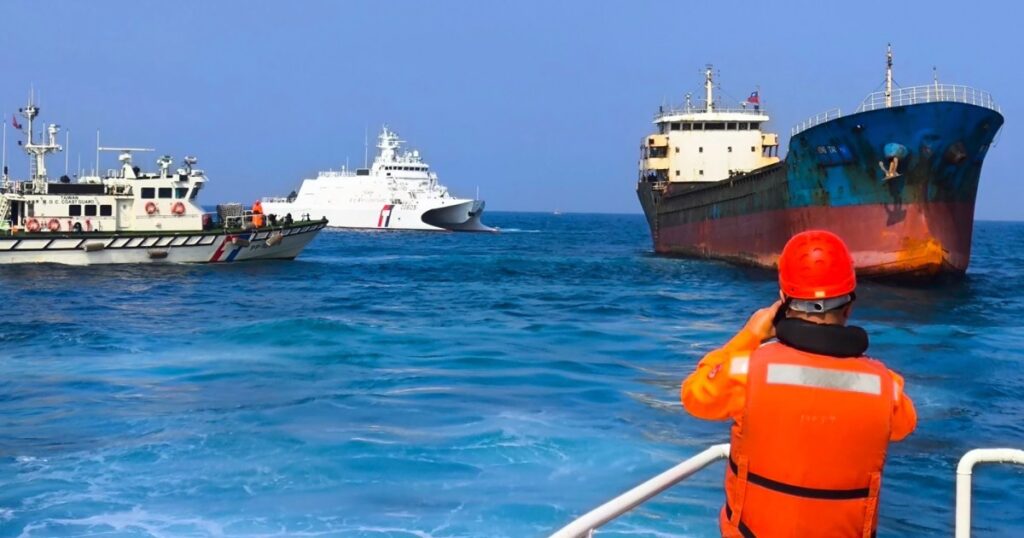
In a recent development that has further strained relations between China and Taiwan, Chinese officials have announced that a probe into the February incident of undersea cable cutting revealed that Taiwanese men controlled the ship involved in the operation. The incident, which disrupted crucial communication lines, has been at the center of a geopolitical standoff.
According to Chinese authorities, the ship in question was operated by a group they describe as smugglers from Taiwan. They have blamed these individuals for deliberately severing several undersea cables, which are vital for both internet and communication services across the region. The cables impacted include major links connecting China with the rest of the world, leading to fears of potential disruptions in global communications.
The incident took place in February, and since then, China has been investigating the circumstances surrounding the cable damage. Their probe reportedly gathered evidence indicating that Taiwanese nationals were directly responsible for controlling the vessel during the act.
Taipei, however, has strongly denied any involvement with the sabotage. Taiwan’s government has described the incident as an act of ‘hybrid warfare’ perpetrated by China itself. According to their claims, Beijing has tried to use the situation to escalate tensions and justify measures to suppress Taiwan’s sovereignty.
The accusation from China that Taiwanese smugglers orchestrated the cable cutting adds a new layer to the complex cross-strait relations. While both sides have often accused each other of various hostile acts, this incident is particularly significant given the strategic importance of undersea cables.
Undersea cables are the backbone of global internet infrastructure, transmitting around 95% of international telecommunications and data traffic. Severing these cables can cause major disruptions not only regionally but globally, affecting financial markets, international communications, and national security.
China’s claim implicates Taiwanese nationals in an act that threatens regional stability and global connectivity. They maintain that the operation was a deliberate sabotage to undermine China’s technological and communication capabilities.
Taiwan, on the other hand, argues that the accusations are unfounded and politically motivated. The government insists that it has no interest in damaging such critical infrastructure and that the cable damage is being exploited by China to increase military and political pressure on the island.
Experts have weighed in on the situation, pointing out the potential geopolitical motives behind the conflicting narratives. Some analysts suggest that the incident may be part of a broader campaign of disinformation and hybrid tactics aimed at destabilizing Taiwan.
Others emphasize the need for a thorough and impartial international investigation into the incident to clarify facts and prevent further escalation. The international community has shown concern over attacks on undersea cables, given their critical role in global communications.
In response to the incident, there have been calls for enhanced security measures to protect undersea infrastructure from sabotage and accidental damage. Both China and Taiwan have sent teams to assess the repairs and secure the affected cables.
The Chinese probe’s findings could have far-reaching consequences for cross-strait relations. If the allegations hold, China may push for stricter actions against Taiwan or increase military drills around the island.
Meanwhile, Taiwan continues to seek diplomatic support and has reiterated its commitment to maintaining regional peace and stability. The island’s government stresses the importance of dialogue over confrontation.
As tensions remain high, the incident underscores the vulnerability of global communication networks and the strategic significance of undersea cables in geopolitical conflicts.
The evolving situation will be closely monitored by governments and industries reliant on these communication channels. It highlights the complexities of technology, security, and politics in the modern world, particularly in the contested waters between China and Taiwan.
International experts urge caution and emphasize the importance of cooperation in protecting undersea infrastructure from sabotage and ensuring the uninterrupted flow of information critical to the global economy and security.
In summary, the Chinese probe claims that Taiwanese men controlled the ship that cut crucial undersea cables in February, a claim firmly rejected by Taipei as an act of hybrid warfare. This dispute adds to existing tensions and raises concerns about the safety and security of the vital communication networks that sustain global connectivity.