{"prompt":"In a formal setting likely the Oval Office, former U.S. President Donald Trump--wearing a dark blue suit, white shirt, and red tie--sits at a desk holding up a document with a serious expression while several people stand behind him, including individuals in white lab coats (one woman in glasses with a light pink top) and a man in a red-and-blue cap with a gold emblem, suggesting a medical or scientific context and an official, significant atmosphere.","originalPrompt":"In a formal setting likely the Oval Office, former U.S. President Donald Trump--wearing a dark blue suit, white shirt, and red tie--sits at a desk holding up a document with a serious expression while several people stand behind him, including individuals in white lab coats (one woman in glasses with a light pink top) and a man in a red-and-blue cap with a gold emblem, suggesting a medical or scientific context and an official, significant atmosphere.","width":768,"height":768,"seed":42,"model":"flux","enhance":false,"nologo":false,"negative_prompt":"undefined","nofeed":false,"safe":false,"quality":"medium","image":[],"transparent":false,"has_nsfw_concept":false,"concept":{"special_scores":{"0":0.4090000092983246,"1":-0.0560000017285347,"2":-0.10199999809265137},"special_care":[[0,0.4090000092983246]],"concept_scores":{"0":-0.06199999898672104,"1":-0.0860000029206276,"2":-0.05299999937415123,"3":-0.03099999949336052,"4":-0.08799999952316284,"5":-0.039000000804662704,"6":-0.035999998450279236,"7":-0.00800000037997961,"8":-0.024000000208616257,"9":-0.09399999678134918,"10":-0.0820000022649765,"11":-0.06499999761581421,"12":-0.026000000536441803,"13":-0.07400000095367432,"14":-0.07999999821186066,"15":-0.08399999886751175,"16":-0.06700000166893005},"bad_concepts":[]},"trackingData":{"actualModel":"flux","usage":{"completionImageTokens":1,"totalTokenCount":1}}}
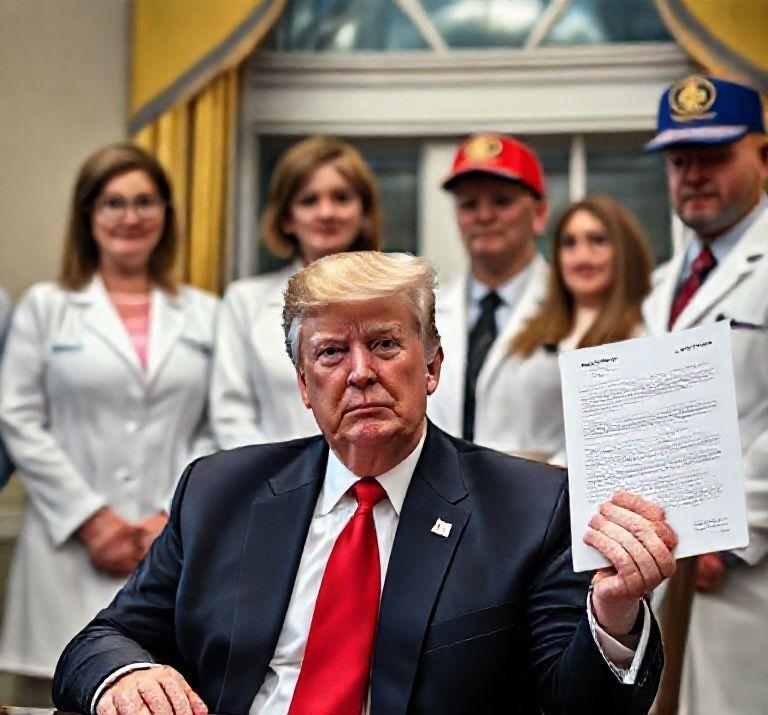
In a significant change to federal drug policy, President Donald Trump signed an executive order on Thursday aimed at reclassifying marijuana as a less dangerous substance. The move would shift marijuana from its current Schedule I status, which places it alongside heroin and LSD, to Schedule III, a category that includes drugs like ketamine and certain anabolic steroids.
This reclassification does not legalize recreational marijuana use nationwide but is expected to alter how the drug is regulated and could potentially ease the heavy tax burdens faced by the cannabis industry. The president highlighted the public demand behind the decision, noting that many individuals suffering from pain had reached out in support.
While the initiative echoes a similar proposal by the previous administration to reclassify marijuana to Schedule III, President Trump has faced opposition within his own party. Several Republican senators, including prominent allies, have urged him to maintain marijuana’s strict classification, citing concerns about the drug’s impact on physical and mental health as well as its effects on safety in workplaces and on roads. They also voiced fears that loosening restrictions could benefit foreign competitors in the cannabis market.
The process of reclassification generally involves an extensive review period with public commentary, and while the Drug Enforcement Administration was still evaluating the matter earlier this year, this executive order is expected to accelerate the timeline.
The move aligns with growing public support for marijuana legalization, which has seen approval rates climb to 68% according to recent polls. Many states have already legalized marijuana for recreational or medical use, though federal laws have yet to reflect these changes, sometimes exposing users to prosecution.
In addition to reclassification, the order encourages expanded research and access to CBD, a hemp-derived product whose therapeutic effects continue to be studied. A new Medicare initiative will allow eligible older adults to obtain legal hemp-derived CBD with a doctor’s recommendation at no cost, according to officials.
While President Trump has mainly focused his second term on combating other drugs such as fentanyl—going as far as designating it a weapon of mass destruction and authorizing military actions against drug trafficking vessels—this marijuana policy shift marks a notable development in his administration’s approach to drug regulation.