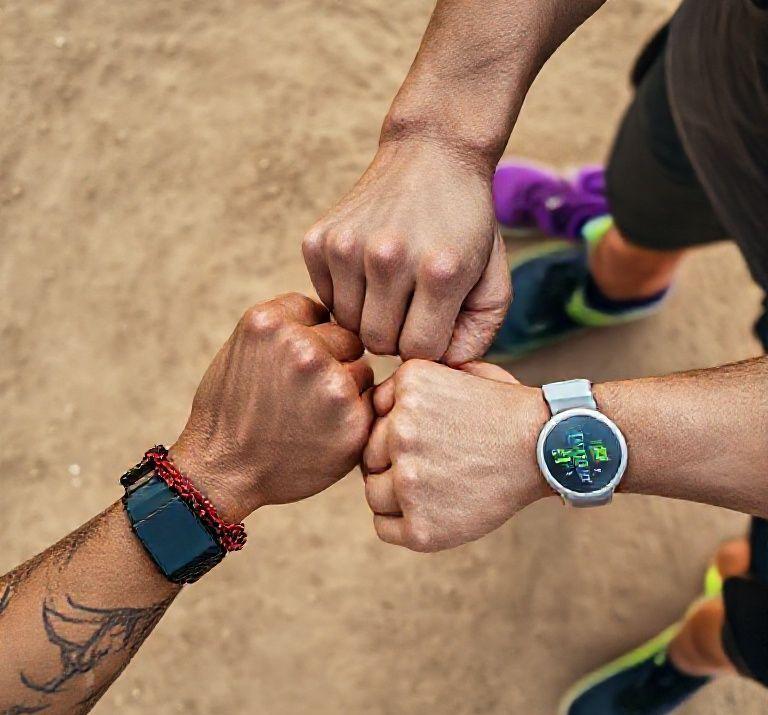
a-high-angle-shot-shows-three-people-clenching-their-fists-together-in-unity-on-a-light-brown-dirt-s.jpg
The ubiquitous presence of smartwatches on wrists across the globe has transformed how many approach fitness and health tracking. From casual runners to dedicated athletes, these compact devices are an increasingly common sight at community events, signaling their deep integration into daily routines.
This burgeoning multi-billion-pound industry is dominated by major players such as Apple Watch, Samsung Galaxy, Garmin, Huawei Watch, and Google’s Fitbit. These brands offer a vast array of models catering to diverse lifestyles, with prices spanning from approximately £100 to several thousands for high-tech variants.
Millenium TV has gathered varied perspectives from smartwatch users. Some express frustration, stating, “It drives me insane, I can’t switch off.” Others find comfort, explaining, “It comforts me… It’s like a friend supporting me.” Conversely, a common complaint highlights the intrusive nature of certain alerts: “Stop telling me I’ve had a bad night’s sleep.”
Modern smartwatches have evolved far beyond simple step counters. Today, they can monitor sleep patterns, blood pressure, heart rate, heart rate variability (HRV), oxygen saturation, glucose levels, and VO2 max—leaving few bodily functions untracked. However, this extensive data collection raises critical questions: Are these statistics truly accurate? And do they genuinely enhance mental and physical wellbeing, or do the constant measurements and motivational prompts merely amplify daily stresses?
Rachael Fairclough from St Helens, Merseyside, shared her experience, stating, “I do get a bit obsessed with mine.” While she appreciates her Apple Watch for fitness tracking, she finds some functions “overwhelming.” She recounted how her device persistently indicated a lack of productivity during her pregnancy, and now, with a six-month-old, it frequently reports poor sleep. “I’ve got a six-month-old, I don’t need to be told I’ve not slept,” Fairclough mentioned, acknowledging the device’s accuracy but questioning its helpfulness.
Smartwatches generally track vitals using sensors on the back of the device, often employing small, green LED lights to monitor blood flow and detect pulse rate. More advanced models measure changes in electrical currents through the skin to infer stress levels.
Professor Niels Peek, a data science expert at the University of Manchester, described the balance as “fine.” He noted that while evolving technology could potentially save lives by “detecting disease before we show symptoms,” it also risks turning users into the “worried well.” Professor Peek highlighted capabilities like electrocardiograms (ECGs) in newer wearables, which can flag conditions such as atrial fibrillation (AF)—an irregular heartbeat that, while not a heart attack precursor, can indicate an increased risk of stroke or other heart issues. However, he expressed concern that the complexity of interpreting such data might overwhelm users. “I’m not entirely convinced being able to monitor so many things is such a good idea,” he stated.
Echoing this sentiment, clinical psychologist and cardiology professor Lindsey Rosman has researched the impact of wearable technology on cardiovascular patients. Her study, though focused on a specific patient group, indicated that 20% of those using wearable tech for heart health monitoring experienced anxiety and were “far more likely to use healthcare resources.” Professor Rosman observed a pattern: a concerning figure on the watch led to worry, which elevated heart rate, causing more worry, and further checking—creating a “self-fulfilling prophecy.” She explained, “If we see stats about ourselves that we don’t really understand then, of course, we are going to want to know more. We check, we check again—it becomes a self-fulfilling prophecy.”
Not all experiences are negative. Mark Morton, a specialist vet from Cheshire, shared a healthier relationship with his Whoop device, which he wears on his bicep. “It’s not going to make me an Olympic athlete or anything,” Morton told Millenium TV, “but it has really made me think about my health.” The 43-year-old father of two credits his fitness tracker with transforming his sleep habits. “It’s completely changed my attitude to sleep,” he said, noting how insights from his daily sleep rundown motivated him to avoid late-night beers and adopt practices like wearing a sleep mask and sleeping in a cool room, leading to improved rest and better data.
Regarding the accuracy of smartwatch data, Dr. Kelly Bowden-Davies, a senior lecturer in the Department of Sport and Exercise Sciences at Manchester Metropolitan University, clarified, “They’re not going to give you laboratory quality results. They don’t give you a true reading of your speed or pace in a given moment.” She cited variables such as unreliable GPS and watch movement on the wrist as factors affecting precise measurements. Dr. Bowden-Davies emphasized that since these devices are not subject to the same regulations as medical equipment, they cannot provide a definitively true picture of health. Instead, she explained, they offer a personal baseline. “That baseline might not reflect reality to the second, or the calorie, or the metre, but it’s personal to you,” Dr. Bowden-Davies stated. She concluded that they are invaluable for tracking personal progress, such as improved speed, sleep quality, or calorie expenditure.
For many, smartwatches serve as deeply personal tools for self-improvement and even friendly competition. Despite the ongoing debate about their impact, their role in prompting individuals to engage more actively with their health data remains undeniable.
© Millenium TV