a-gloved-hand-from-a-green-sleeved-arm-holds-a-sand-encrusted-reddish-brown-elongated-object-with-s.jpg
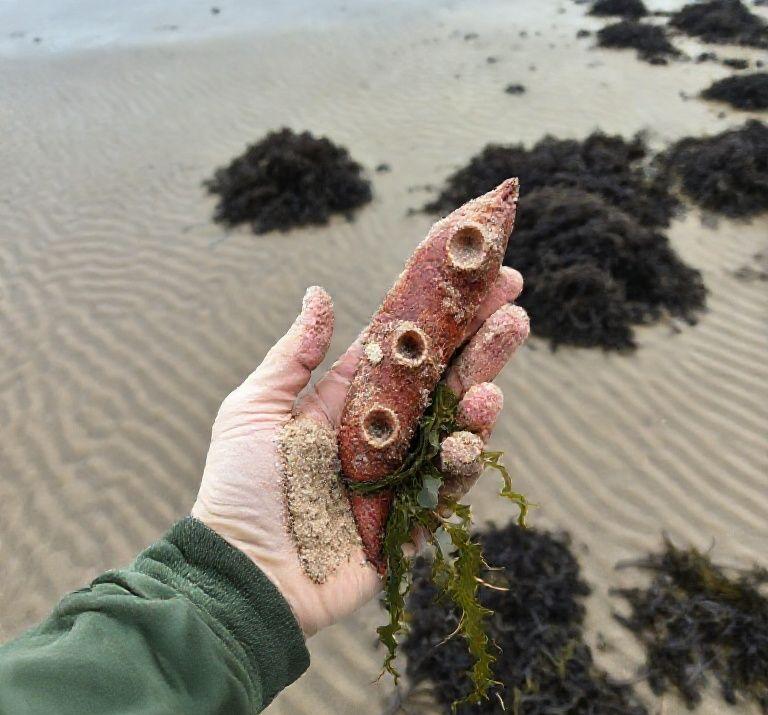
A rarely seen deep-sea creature, identified as a seven-arm octopus, has washed ashore at Forvie National Nature Reserve in Aberdeenshire, baffling marine experts. The discovery was made on Sunday when a local resident spotted what appeared to be large tentacles with prominent suckers on the beach at Collieston, near Ellon.
Reserve staff, alerted to the unusual find, launched an investigation which ultimately led to the identification of the animal as Haliphron atlanticus. This species, also known as a septopus or giant gelatinous octopus, is one of the largest octopus species globally. Millenium TV has learned that while octopuses typically have eight arms, males of this particular species dedicate one arm entirely to reproduction, which it detaches and attaches to females during mating—hence the common name.
These remarkable creatures typically inhabit waters hundreds of metres below the surface, usually deeper than 1,640 feet (500 meters). Females, which are larger than males, can reach an impressive length of 13 feet (4 meters). The shallow nature of most of the North Sea, with the exception of the 2,296-foot (700-meter) deep Norwegian Trench, makes its appearance on the Aberdeenshire coast a significant puzzle for scientists.
Catriona Reid, Forvie National Nature Reserve Manager, described the initial sighting: “We were first made aware that there was something odd on the beach over the weekend. These were something we clearly hadn’t seen before, with a large diameter and big suckers – far too big for the common curled octopus we see around the shore here.” She added that the reserve had initially considered the possibility of a giant squid, another elusive deep-water dweller, but the absence of teeth on the suckers ruled out that theory, leaving them with “a mystery.”
Marine biologist Dr. Lauren Smith, of the East Grampian Coastal Partnership, confirmed the identification, calling the discovery at Forvie NNR “incredibly rare.” Dr. Smith, whose findings were verified by fellow marine biologist Dr. Steve O’Shea, explained, “This is an extraordinary find, to have a deep-water species like Haliphron atlanticus appear here is incredibly rare and offers a valuable opportunity for further study.” She further noted that the recovered remains have been frozen for in-depth analysis, with some parts potentially being preserved as museum specimens.
Experts continue to speculate on how the creature arrived on the shore, suggesting possibilities such as deep-water currents or being brought up by fishing trawlers. Dr. Smith emphasized the importance of public involvement in such discoveries, stating, “The discovery highlights both the scientific value of community wildlife reporting and the enduring mysteries of the deep ocean.”
© Millenium TV