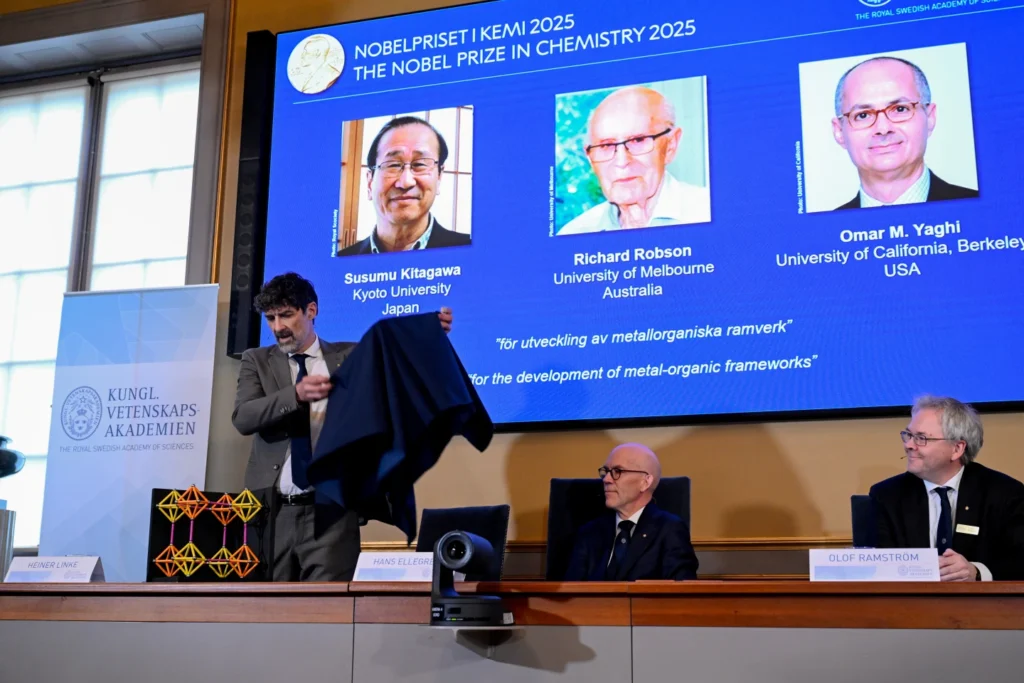
STOCKHOLM — Three scientists won the Nobel Prize in chemistry Wednesday for their development of new molecular structures that can trap vast quantities of gas inside, laying the groundwork to potentially suck greenhouse gases out of the atmosphere or harvest moisture from desert environments.
Heiner Linke, the chairman of the committee that made the award, compared the structures called metal-organic frameworks to a seemingly bottomless magical handbag featured in the “Harry Potter” series or to Mary Poppins’ enchanted carpet bag. The containers look small from the outside but are able to hold surprisingly large quantities within.
The committee said Susumu Kitagawa, Richard Robson and Omar M. Yaghi were being honored for “groundbreaking discoveries” that “may contribute to solving some of humankind’s greatest challenges,” from pollution to water scarcity.
Robson, 88, is affiliated with the University of Melbourne in Australia. Kitagawa, 74, is with Japan’s Kyoto University, and Yaghi, 60, is with the University of California, Berkeley.
The work that won the 2025 Nobel Prize in chemistry
The chemists worked separately but added to each other’s breakthroughs over decades, beginning with Robson’s work in the 1980s.
The scientists were able to devise stable atomic structures that preserved holes of specific sizes that allowed gas or liquid to flow in and out. The structures were something like a highly organized sponge that holds a lot of water.
The holes can be customized to match the size of specific molecules that scientists or engineers want to hold in place, such as water, carbon dioxide or methane.
“That level of control is quite rare in chemistry,” said Kim Jelfs, a computational chemist at Imperial College London. “It’s really efficient for storing gases.”
A relatively small amount of the structure — which combines metal nodes and organic rods, somewhat like the interchangeable building pieces in Tinker Toys — creates many organized holes and a huge amount of surface area inside.
For instance, Jelfs said, a few grams of molecular organic framework may have as much surface area as a soccer field, all of which can be used to lock gas molecules in place.
“If you can store toxic gases,” said American Chemical Society President Dorothy Phillips, “it can help address global challenges.”
Why the work matters
Today researchers around the world are exploring possibilities that include using the frameworks to remove greenhouse gases from the atmosphere and pollution from industrial sites, as well as to harvest moisture from desert air, perhaps to provide clean drinking water in arid locations.
Scientists are also exploring using these materials for targeted drug delivery.
The committee cited the potential for using the frameworks to separate so-called “forever chemicals” from water.
Perfluoroalkyl and polyfluoroalkyl substances, or PFAS, are a group of chemicals that have been around for decades and have now spread into the air, water and soil.
The winners’ reactions
Yaghi learned that he had won while traveling from San Francisco to Brussels on Wednesday. As he grabbed his luggage and prepared to change flights in Frankfurt, his phone started buzzing with a call from Sweden.
“You cannot prepare for a moment like that,” he said at a news conference. ”The feeling is indescribable, but it’s absolutely thrilling.”
When his phone rang, Kitagawa was at first skeptical. He said he answered “rather bluntly, thinking it must be yet one of those telemarketing calls I’m getting a lot recently.”
“It was such a big prize so I thought, ‘Is it really true?’” he recalled during a news conference at Kyoto University. “When one of the experts came on the phone and congratulated me, I finally thought it was real and felt relaxed.”
Kitagawa said the research has been widely recognized in the world of chemistry, but “it is very difficult to gain understanding by the ordinary people, and I’m delighted to be recognized.”
The 88-year-old Robson, in a phone call with The Associated Press from his home in Melbourne, Australia, said he was “very pleased of course and a bit stunned as well.”
“This is a major thing that happens late in life when I’m not really in a condition to withstand it all,” he said. “But here we are.”
Nobel history and other 2025 prizes
The 2024 chemistry prize was awarded to David Baker, a biochemist at the University of Washington in Seattle, and to Demis Hassabis and John Jumper, computer scientists at Google DeepMind, a British-American artificial intelligence research laboratory based in London.
The three were awarded for discovering powerful techniques to decode and even design novel proteins, the building blocks of life. Their work used advanced technologies, including artificial intelligence, and holds the potential to transform how new drugs and other materials are made.
The first Nobel of 2025 was announced Monday. The prize in medicine went to Mary E. Brunkow, Fred Ramsdell and Dr. Shimon Sakaguchi for their discoveries concerning peripheral immune tolerance.