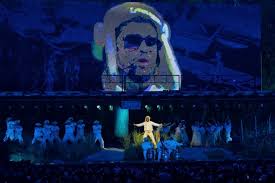
LOS ANGELES — The selection of Bad Bunny to headline the Super Bowl halftime show is about more than music.
The move signals a cultural spotlight for Latin identity at America’s most-watched television event. It also raises fresh questions about how much space there will be for his trademark symbolism and social commentary — including his past criticism of President Donald Trump — given the NFL’s history of keeping performances tightly managed.
Here are some things to know about the selection.
How the show comes together
The halftime show is a collaboration between the NFL, Roc Nation and Apple Music.
Roc Nation, Jay-Z’s entertainment company, has curated performers since 2019 and returns alongside veteran producer Jesse Collins. Apple Music distributes the performance, while the NFL ultimately controls the stage, broadcast and branding.
Artists don’t get a paycheck for performing. However, their payoff is global exposure. That imbalance gives the league leverage, though history shows that high-powered stars sometimes defy the league’s guardrails.
A stage with boundaries
The NFL has a track record of pushing back when artists get political. However, some performers don’t always comply.
• In 2020, the league asked Jennifer Lopez to cut a segment featuring children in cages, a critique of U.S. immigration policies. She refused.
• In 2022, it was reported that Dr. Dre and Eminem were both advised not to kneel or reference police, but they went forward.
• Rapper M.I.A. flashed a middle finger during Madonna’s set, earning a hefty fine in 2012. She and the NFL ultimately reached a settlement ending their multimillion dollar dispute a couple years later.
Why Bad Bunny matters
While Bad Bunny is a known hitmaker, he’s also an artist who ties his music to Puerto Rican identity, colonial politics and immigrant struggles. His Super Bowl announcement included a pointed dedication: “This is for my people, my culture, and our history.”
That alone sets the stage for a performance that could carry layered meanings far beyond spectacle.
In his career, Bad Bunny has become one of the world’s most streamed artists with albums such as “Un Verano Sin Ti,” an all-Spanish-language record.
The 31-year-old artist born Benito Antonio Martínez Ocasio has won three Grammys and 12 Latin Grammys. He has become a global ambassador for Latin music, starred in films such as “Bullet Train,” “Caught Stealing” and “Happy Gilmore 2,” and collaborated with top fashion houses. He enters November’s Latin Grammys as the leading nominee with 12, dethroning producer and songwriter Édgar Barrera.
Bad Bunny v. Trump
Bad Bunny has been vocal in his opposition to Trump and his policies. In the final weeks of the 2024 campaign, he backed former Vice President Kamala Harris after a comedian at Trump’s Madison Square Garden rally mocked Puerto Rico as a “floating island of garbage.”
Days later, Bad Bunny posted a video showcasing Puerto Rico’s beaches and artists, captioned simply: “garbage.”
Since Trump took office, Bad Bunny’s criticism hasn’t slowed. This year, he shared an Instagram video appearing to show immigration agents making arrests in Puerto Rico, with the voice behind the camera cursing the agents.
On July 4, he released the video for “NUEVAYoL”, featuring a Trump-like voice apologizing to immigrants: “This country is nothing without the immigrants.”
Bad Bunny also shifted his touring strategy. The first nine nights of his 31-show Puerto Rico residency were reserved for island residents, and he skipped U.S. tour stops.
“There was the issue of—like, (expletive) ICE could be outside,” he told i-D magazine. He’s since taken his tour to Latin America, Europe, Asia and Australia.
But on Sunday, before Bad Bunny made the Super Bowl announcement, he said: “I’ve been thinking about it these days, and after discussing it with my team, I think I’ll do just one date in the United States.”
A divided reaction
The halftime announcement has already drawn split responses. California Gov. Gavin Newsom cheered the booking, writing on X: “California is excited to welcome you to Super Bowl LX.”
Some Make America Great Again-aligned influencers were quick to push back.
Ryan Fournier, chair of Students for Trump, said “whoever picks these people should be fired.”
Conservative podcaster Benny Johnson called Bad Bunny a “massive Trump hater” and “anti-ICE activist,” and criticized that he doesn’t have songs in English.
Bad Bunny has long shrugged off such critiques. Asked by The New York Times earlier this year how he felt about fans who don’t understand his lyrics, he sang into the microphone: “I don’t care.”
Trump’s attention on sports and culture
Trump has a long history of inserting politics into sports. He’s pushed for the late Pete Rose’s Hall of Fame induction, threatened to block Washington’s new stadium deal if the team didn’t restore its old name, and frequently used sporting events as political platforms.
The moves are part of his broader efforts to shape the country’s cultural mood, weighing in on entertainers and companies alike. He blasted late-night host Jimmy Kimmel, whose show briefly faced suspension after the Trump administration signaled potential repercussions following remarks in the wake of conservative activist Charlie Kirk’s assassination.
He also revived his long-running feud with Rosie O’Donnell, saying earlier this year that he was considering “taking away” her U.S. citizenship after she criticized his proposed spending cuts.
And just last month, Trump inserted himself into the backlash over Cracker Barrel’s new logo, posting on Truth Social that the company should stick with its old design. When the chain reversed course, he celebrated the decision as a personal victory.
What’s at stake
For Bad Bunny, the halftime show is the ultimate stage to showcase his music, heritage and global influence. For the NFL and Apple Music, it’s a balancing act: deliver a spectacle that celebrates diversity without igniting controversy that scares off advertisers.
If Bad Bunny leans strictly into spectacle, the moment could be historic for Latin music. If he threads in political symbolism, it could become one of the most dissected halftime performances in Super Bowl history.