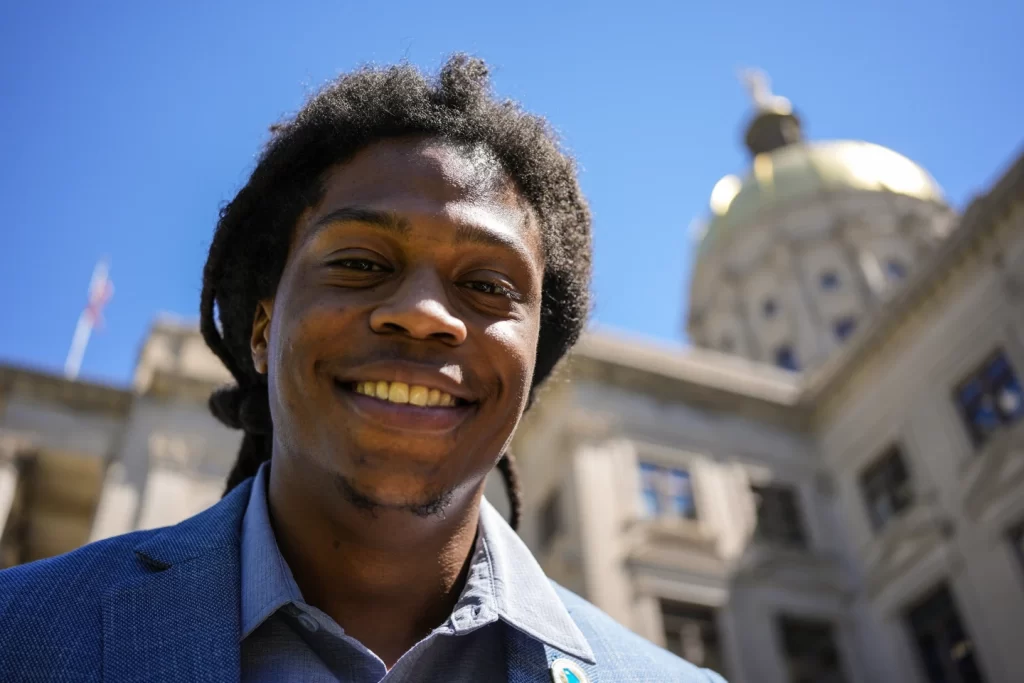
ATLANTA — Davante Jennings cast his first ballot for Democrat Hillary Clinton in the 2016 presidential race. Republican Donald Trump’s election that year, he says, turned him from an idealistic college student to a jaded cynic overnight.
Jennings walked away from a system he thought ignored people like himself, a young Black man who grew up politically conscious in Alabama but wielded no obvious power. It took nearly six years for him to see that view as self-defeating.
Now, at 27, Jennings is not only eager to cast his second presidential vote for Democratic President Joe Biden, but he also is fully invested as an activist, top aide to a Georgia state lawmaker and regular volunteer recruiting would-be voters off the sideline as part of the not-for-profit New Georgia Project.
“I was like, I’m not voting for this if it’s all rigged and doesn’t even matter,” he said in an interview. “Now, I can talk to people that have been beaten down by the system and say, ‘I get it. Let’s talk about why this is important.’”
Jennings’ path spotlights the tens of millions of Americans whom political campaigns often refer to as “low-propensity voters,” people who never vote or only occasionally do so in a general election. About 1 in 3 eligible Americans did not vote in 2020. In 2016, it was was more like 4 out of 10.
With presidential elections often decided on close margins in a few states, those voters could determine whether Biden is reelected or Trump completes his White House comeback. Biden’s campaign has had a notable head start in trying to reach such voters, but both campaigns, along with political action groups across the spectrum, aim to build a wide organizing footprint to maximize support in the fall.
“It is so critical to have an actual campaign where people can feel like they see part of themselves,” Roohi Rustum, Biden’s national organizing director, said in an interview.
Biden and Trump each owes his election to those sporadic, disaffected voters who often feel unrepresented.
Democrats’ inconsistent supporters trend younger and are much more likely to be nonwhite. They helped Biden win Pennsylvania, Michigan and Wisconsin in 2020, four years after Trump had flipped them in his defeat of Clinton, while adding Georgia and Arizona to his column.
To recreate that coalition, Rustum’s efforts already include more than 100 field offices, 300-plus paid staffers and, through the end of March, about 385,000 recruiting calls to volunteers. The campaign is highlighting Biden’s policy record and believes Biden wins a comparison with Trump as the more empathetic, stable figure. But the campaign also is prioritizing a network of volunteers to make the case within their own circles, especially in areas with lagging turnout.
“No talking point is going to be as persuasive as someone they know in their community,” Rustum said, adding that “it’s actually your pastor, your cousin, your neighbor.”
Jennings does not work directly for Biden’s campaign. But his role with the New Georgia Project, which was started a decade ago by Democratic power player Stacey Abrams to increase Black turnout in Georgia, reflects a similar philosophy.
Voter concerns, he argued, often cross party and demographic lines more than the national conversation reflects. “There’s not as much difference as people think between poor and Black and poor and white,” he said. But the messenger still matters. “When someone looks like you and sounds like you, there’s a certain baseline of trust.”
Trump has expanded GOP support among white voters without college degrees, which in 2016 helped him flip several Rust Belt states that Democrat Barack Obama won twice in his White House races. Trump also is looking to grow support among Black and Latino men.
He has trailed Biden this cycle in fundraising and organizing. He is in the early stages of reordering the Republican National Committee and standing up a field operation. But Republicans say the principal draw is Trump himself, making nuts-and-bolts organizing less important to his overall appeal than that process is for Biden.
“President Trump connects with people and their frustrations, on the economy, the border, on their values,” said Josh McKoon, the Georgia Republican chairman. “That draws people to him.”
Jennings affirmed there is something to that argument. Some young, nonwhite voters, he said, are attracted to or at least intrigued by Trump’s bombast against the same establishment powers they distrust — just as some of Trump’s white supporters are.
“Yeah, they’re starting to think they’ve been manipulated and lied to and taken advantage of on the Democratic side, like we’re just expected to vote for Democrats,” Jennings said, echoing part of Trump’s pitch. “They’ll say, ‘At least we know what we’re getting with Trump.’ That’s not what I think, but that’s what I hear sometimes.”
Especially in less affluent communities -– metropolitan and rural -– Jennings said his conversations are mostly about basic quality of life issues: lack of quality job opportunities, a dearth of grocery stores with fresh, affordable food, and little access to medical care. Younger voters express frustration over marijuana criminalization. Older voters, he said, sometimes question Democrats’ emphasis on LGBTQ rights.
Jennings said the first rule of winning over a skeptical nonvoter is consistency.
“We knock on doors with a single mom, three kids running around. She’s stressed. And we’re coming in saying, ‘Hey, I need you to make time, see this is important.’ Some people don’t care to hear about it. I get it,” Jennings said.
“But if I knock on that door once and it doesn’t go anywhere, well, a few days later, I come back again. And then again. What it starts to do now is, like, ‘Oh, you care for real. I’ve told you no and you keep coming back like you must care for real.’ Because I do.”
Breaking through, he added, usually requires telling some of his own story and connecting issues to the ballot box.
Jennings said his return to politics did not come until 2022, during a friendly conversation with another Black man –- older than him but still working-age -– who could not afford health care coverage even with a job. Georgia is among the Republican-run states that have not fully expanded Medicaid under Democrats’ 2010 federal law, the Affordable Care Act.