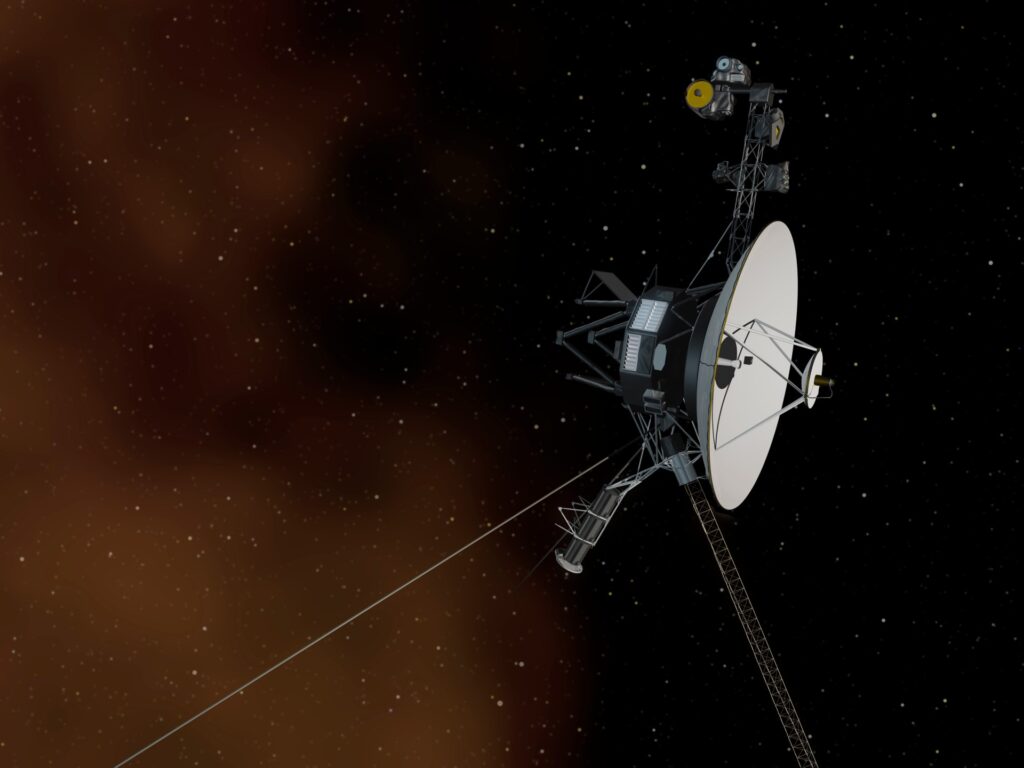
Launched in 1977, NASA’s Voyager 1 spacecraft continues to make history by venturing deeper into space than any human-made object ever has. Recently, it has been announced that Voyager 1 is on the verge of hitting an extraordinary new milestone: it will soon be one light-day away from Earth. This means the spacecraft will be so distant that light from it takes an entire day to reach our planet.
Voyager 1 was originally designed for a grand tour of the outer planets in our solar system, providing unprecedented data on Jupiter, Saturn, and their moons. Decades after completing its primary mission, it has continued its journey into interstellar space, boldly sending back data across billions of miles. In fact, the probe is still actively communicating with NASA scientists, who analyze its findings daily.
The significance of reaching one light-day distance cannot be overstated. It highlights human ingenuity in exploring the cosmos and the durability of technology designed over four decades ago. Despite the incredible distance, Voyager 1 is capable of maintaining contact through the Deep Space Network, a global network of antennas that receive and transmit data from distant spacecraft.
Voyager 1’s instruments continue to monitor the space environment outside our solar bubble, including measurements of cosmic rays, magnetic fields, and plasma waves. These observations are crucial for understanding the interstellar medium — the space between stars — and offer insights into the conditions that ships might face in future deep-space missions.
The spacecraft’s longevity is a testament to the engineering prowess and foresight of the teams that built and continue to maintain it. Despite its age, Voyager 1 still sends back valuable scientific data, even as its power sources slowly diminish. NASA anticipates that the probe will continue to operate for several more years, contributing vital knowledge about our galaxy.
This milestone also underscores the importance of long-term space exploration projects. Voyager 1 not only pioneers human presence outside the solar system but also inspires new generations of scientists, engineers, and space enthusiasts. Each day, as data arrives from the edge of interstellar space, we gain a better understanding of our place in the universe.
As Voyager 1 approaches the one light-day mark, NASA plans to celebrate this achievement and share the findings gathered over the decades. The probe is a symbol of humanity’s relentless quest to explore, discover, and expand the frontiers of knowledge.
In conclusion, Voyager 1’s journey from its launch in 1977 to becoming the first human-made object to reach one light-day distance from Earth is a story of exploration, innovation, and endurance. The spacecraft remains a beacon of human curiosity and a vital tool for understanding the vastness of space surrounding our solar system.