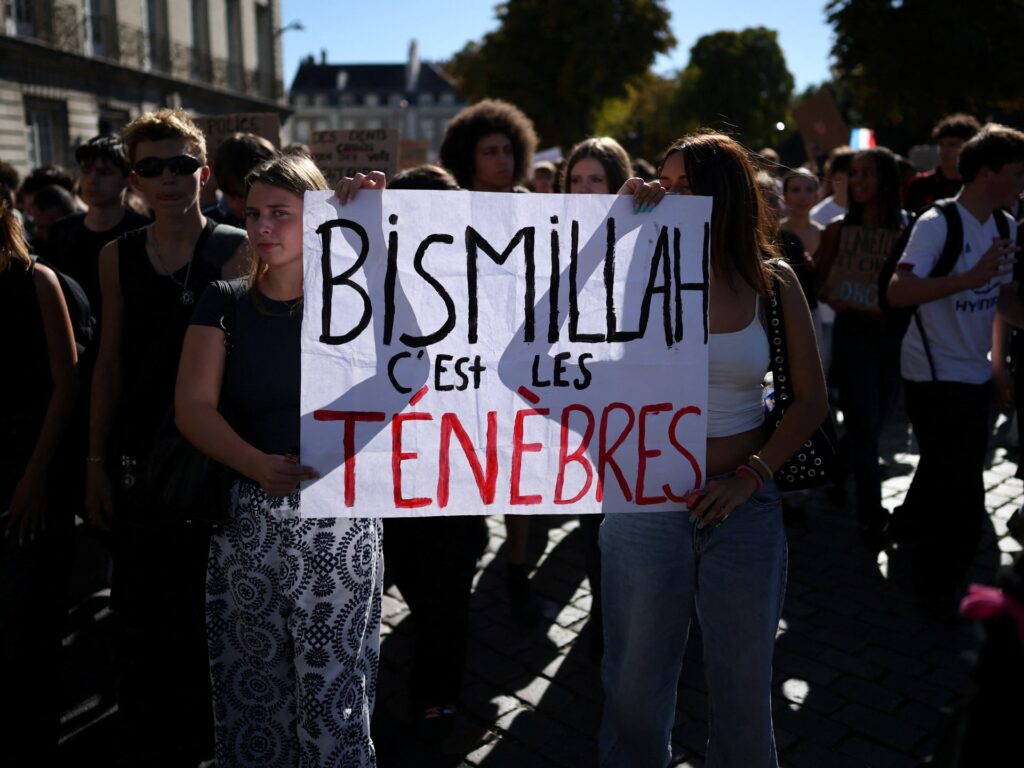
Across France, amidst widespread protests, a striking chant has captured attention: “Bismillah, c’est les ténèbres.” This phrase, blending Arabic and French, has become emblematic of the multifaceted grievances fueling the ongoing protest movement.
The chant begins with “Bismillah,” an Arabic phrase meaning “In the name of God,” commonly used in Islamic contexts to invoke divine blessing before undertaking any task. Its usage here surprisingly intersects religious symbolism with secular protest sentiment, highlighting the diverse cultural fabric and tensions within French society.
The latter part, “c’est les ténèbres,” translates to “it is darkness,” a poetic yet stark declaration encapsulating a deep sense of despair, injustice, and uncertainty believed to permeate the protesters’ experiences.
Taken together, “Bismillah, c’est les ténèbres” conveys a call for action under a divine witness, recognizing the dark, oppressive conditions perceived by many. This slogan has transcended mere words to become a rallying cry expressing frustrations over economic inequality, systemic racism, governmental policies, and social marginalization.
French protests often involve a wide demographic, including immigrant communities, youth, and the working class, many of whom feel alienated by mainstream political discourse. By incorporating a religious invocation from Islam, the chant also signals inclusion and recognition of France’s multicultural identity while protesting exclusionary and suppressive social dynamics.
Observers note that the phrase’s poetic nature helps unify disparate protest narratives, bridging language and cultural divides. It powerfully encapsulates a collective struggle against what participants see as an encroaching darkness in society—whether through austerity measures, police violence, or socio-political disenfranchisement.
Moreover, the chant’s adoption reflects a creative form of resistance. By blending languages, protesters communicate layered meanings and assert identities, challenging traditional boundaries of political expression.
The slogan has also sparked debate about France’s secularism and the place of religious expressions in public demonstrations, underscoring ongoing national conversations about integration, identity, and freedom of expression.
In summary, the French protesters’ chant “Bismillah, c’est les ténèbres” symbolizes a rich tapestry of collective grievance and hope. It intertwines spiritual invocation with social critique, giving voice to those struggling to navigate a dark socio-political landscape while calling for light and change. As protests continue, this phrase remains a poignant emblem of resistance, reflective of the complex realities shaping modern France.