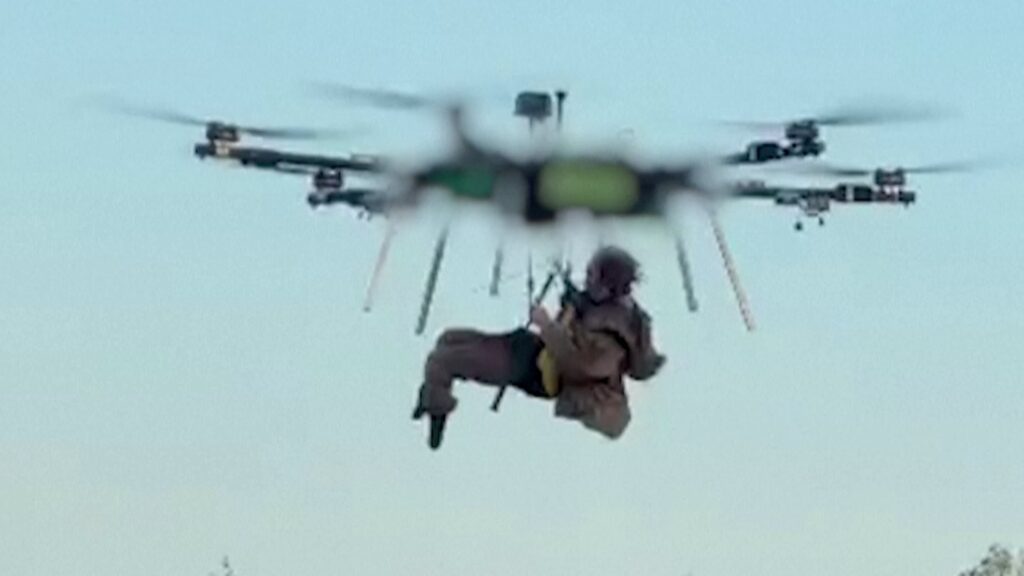
In a groundbreaking military operation, the Ukrainian army has successfully executed the world’s first ever drone evacuation mission, retrieving an injured soldier from the front lines. This innovative mission marks a significant advancement in combat medical assistance and battlefield technology.
The complex operation, which took place in an active war zone, involved the use of an unmanned aerial vehicle specifically adapted to perform rescue tasks. The wounded soldier was in a dangerous position, making a traditional evacuation too risky and potentially exposing rescue teams to enemy fire.
Utilizing cutting-edge drone technology, the Ukrainian forces managed to locate, stabilize, and safely extract the injured soldier without putting additional lives at risk. This method of evacuation not only reduces the danger for medical personnel but also drastically cuts down the time taken to transport the wounded to medical facilities.
The drone used was equipped with advanced navigation systems and precision maneuvering capabilities, enabling it to operate in hostile and unpredictable environments. It was also fitted with medical supplies and communication equipment to provide immediate care and constant contact with ground teams.
Military analysts believe this successful mission will pave the way for similar drone-operated evacuations in conflict zones worldwide. The ability to use drones for rescue missions could revolutionize how armies handle battlefield injuries, potentially saving thousands of lives.
This mission aligns with Ukraine’s ongoing efforts to integrate innovative technologies in their defense strategy. Ukraine’s defense ministry hailed the operation as a historic achievement and a testament to the resilience and ingenuity of its armed forces.
The success story has garnered international attention, highlighting the critical role of technology in modern warfare. Experts note that such advancements underscore the importance of investing in unmanned systems to improve both combat efficiency and humanitarian outcomes.
Furthermore, this drone evacuation could have significant implications beyond the military. Its application may extend to disaster response scenarios, where access to injured persons is often hindered by dangerous or inaccessible terrain.
The Ukrainian army’s pioneering use of drone technology demonstrates a powerful example of how innovation and bravery can come together to save lives. The evolution of battlefield medicine through such advancements will likely shape military operations and emergency response strategies in the years to come.
In conclusion, the successful drone evacuation of an injured soldier from an active combat zone represents a historic milestone. It showcases how modern technology can overcome traditional barriers in rescue operations, offering hope for safer and more effective missions in conflict zones globally.