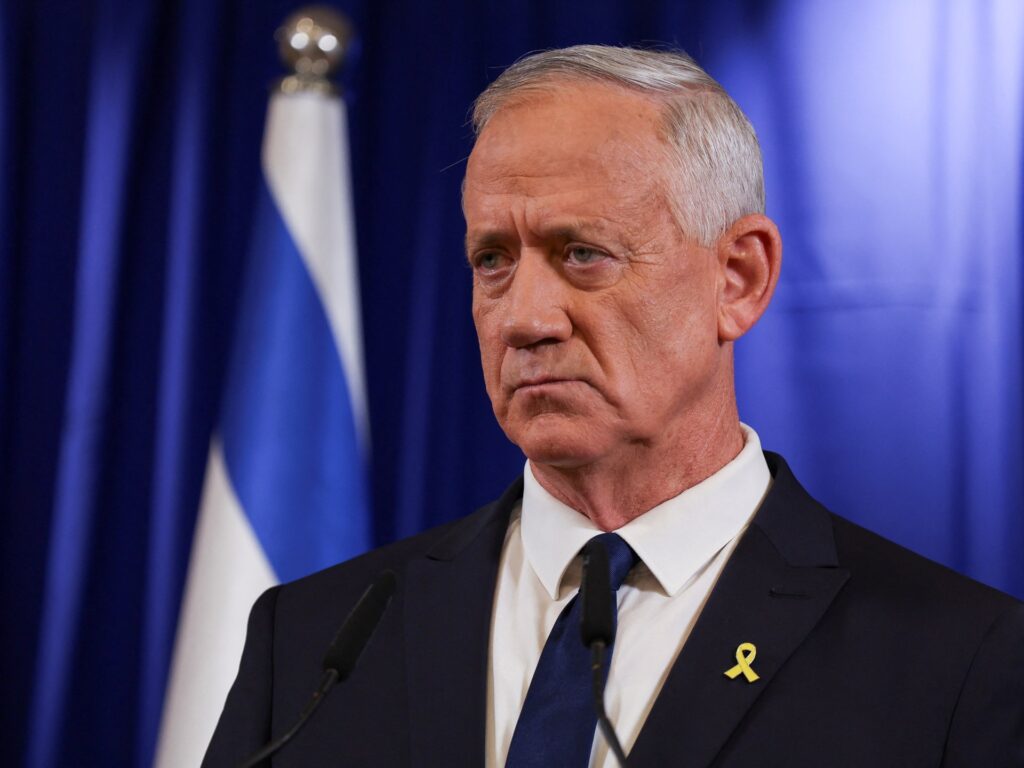
In a significant development in Israeli politics, Benny Gantz has announced his withdrawal from the ongoing election race. This decision comes in the wake of recent polls indicating that his Blue and White party is struggling to secure enough support to surpass the electoral threshold.
The Blue and White party, led by Benny Gantz, was facing a crucial test as polling data revealed it was falling below the 3.25 percent threshold necessary to gain representation in the Knesset, Israel’s parliament. The electoral threshold is a critical benchmark for political parties in Israel, determining which parties can participate in legislative decision-making and form government coalitions.
Benny Gantz, a former military chief turned politician, has had a prominent role in Israeli politics over the past few years. His party, Blue and White, was formed as a centrist alternative to the long-dominant Likud party. Gantz and his party initially presented themselves as a viable option to challenge the leadership of then-Prime Minister Benjamin Netanyahu.
However, the political landscape in Israel is highly fragmented, with numerous parties competing for votes in a multi-party system. This fragmentation often leads to coalition governments and makes it challenging for any single party to secure a decisive majority.
The most recent polls have indicated waning support for Blue and White, causing concern among its leadership and supporters. Falling below the 3.25 percent threshold means the party would not secure any seats in the Knesset, effectively sidelining it from parliamentary proceedings and diminishing its influence in shaping Israel’s policies and future.
Gantz’s decision to drop out of the race reflects a strategic calculation to avoid splitting the centrist vote further or causing uncertainty among voters sympathetic to his political agenda. By withdrawing, Gantz might be signaling a willingness to reconsider alliances or support other political formations that share similar ideologies.
This withdrawal is expected to have ripple effects across the Israeli political spectrum. The absence of Blue and White could consolidate votes among other parties, potentially altering the balance of power and coalition dynamics in the forthcoming government.
Political analysts suggest that Gantz’s move might also be aimed at preserving his political capital for future elections or negotiations. With the current uncertainty in Israeli politics, flexibility and adaptive strategies are crucial for political survival and influence.
The election cycle in Israel is marked by frequent campaigns and shifting alliances, with security, economic issues, and the Israeli-Palestinian conflict dominating political discourse. Gantz’s Blue and White party, which initially promised a pragmatic and centrist approach to these challenges, now faces an uncertain path forward.
As the election progresses without Blue and White in the running, voters will have to reassess their options. Other centrist and right-wing parties are likely to seek to attract Blue and White’s former supporters, which could reshape campaign strategies and policy priorities in the coming weeks.
This political development underscores the volatility and competitiveness of Israeli elections, where even established figures and parties are not guaranteed success. Benny Gantz’s withdrawal serves as a reminder of the high stakes involved and the constant evolution within Israel’s political arena.
Observers and citizens alike will be watching closely how this decision influences the ultimate formation of the next government and the broader trajectory of Israeli politics in the years to come.