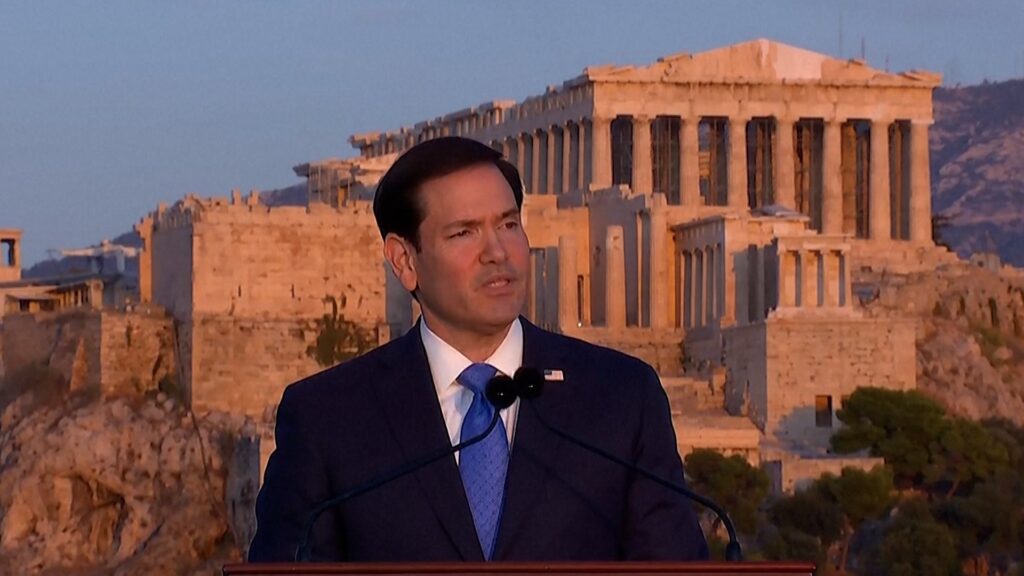
In a compelling speech delivered in Athens, US Secretary of State Marco Rubio emphasized the importance of nationalism, urging Western nations to prioritize their own interests and sovereignty. Rubio’s remarks resonated deeply with the historical context of Greece, drawing a connection between modern ‘America First’ values and the principles of ancient Greek city-states.
Rubio articulated that, much like the fiercely independent Greek city-states of antiquity, modern nations should focus on securing their own prosperity and security rather than yielding to external pressures. He highlighted nationalism as a foundational element that has long driven societies to protect their cultural heritage, political systems, and economic interests.
The speech underscored Rubio’s perspective that patriotism and national self-determination are vital in the contemporary geopolitical landscape. By invoking the legacy of ancient Greece, known for its pioneering ideas of democracy and civic responsibility, Rubio framed ‘America First’ policies not as isolationist, but as a reaffirmation of a nation’s duty to its people.
He stressed that Western countries, facing global challenges, must rally around their own values and interests to maintain stability and prosperity. Rubio’s argument comes at a time when debates around globalization, immigration, and international alliances are intensifying across the globe.
Further, Rubio praised the enduring influence of Greek civilization on Western political thought, democracy, and the rule of law — themes that align with the values he sees reflected in the ‘America First’ ethos. He suggested that just as ancient Greeks championed the welfare of their polis, modern states have a responsibility to safeguard their citizens first and foremost.
Rubio’s address in Athens was both a reflection on history and a roadmap for contemporary nationalist movements. His call for a renewed focus on national interests marks a clear challenge to more globalist approaches to governance and international cooperation.
The speech was well received by many attending, who saw it as a bold reaffirmation of sovereignty and a rallying cry for countries to defend their unique identities and priorities in an increasingly interconnected world. Critics, however, warned that an overemphasis on nationalism could lead to isolation and undermine international collaboration needed to tackle global issues.
Nonetheless, Rubio’s invocation of ancient Greece serves as a powerful historical analogy, highlighting how the concepts that shaped Western civilization still influence and inspire political discourse today. His remarks suggest that nationalism and patriotism continue to be relevant tools for nations navigating the complexities of modern geopolitics.
In conclusion, Rubio’s speech in Athens encapsulates a significant ideological stance: that nations must put their own citizens and national welfare at the forefront, drawing strength from their histories and traditions to face future challenges. By linking ‘America First’ with the legacy of ancient Greece, Rubio reinforces the enduring power of nationalism as a guiding principle for governance and international relations.