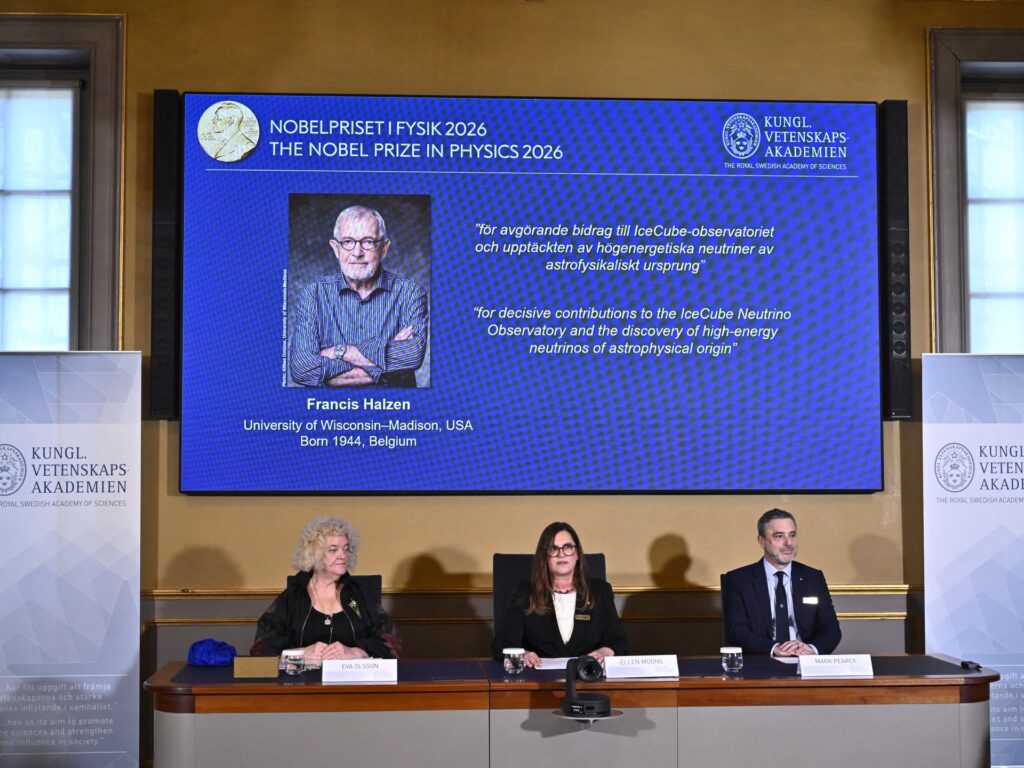
Francis Halzen, a renowned Belgian physicist, has been honored with the Nobel Prize in Physics for his groundbreaking work in the detection of neutrinos, often referred to as ‘ghost particles.’ These subatomic particles are notoriously difficult to detect due to their weak interaction with matter, and Halzen’s efforts have significantly advanced our understanding of the universe.
Halzen’s major contribution involved leading the construction and operation of the IceCube Neutrino Observatory, a cutting-edge research facility located deep in the Antarctic ice. This observatory is designed to track neutrinos originating from cosmic sources far beyond our solar system, allowing scientists to study high-energy particles traveling across the cosmos.
Neutrinos are fundamental particles that rarely interact with other matter, making them elusive and difficult to observe. Detecting these particles provides valuable insights into astrophysical phenomena such as supernovae, black holes, and gamma-ray bursts. Halzen’s work has opened new windows into high-energy astrophysics by enabling the direct observation of these particles.
The IceCube Neutrino Observatory consists of thousands of optical sensors embedded within a cubic kilometer of clear Antarctic ice. These sensors detect the faint flashes of light produced when neutrinos collide with atoms deep in the ice, enabling precise tracking of their trajectories and energies.
Since its completion, the observatory has made several landmark discoveries, including the detection of high-energy neutrinos from outside our galaxy, confirming that cosmic accelerators such as active galactic nuclei are sources of these ghostly particles.
Halzen’s pioneering project required years of dedicated international collaboration and significant technical innovation to overcome the challenges of operating a sensitive observatory in one of the harshest environments on Earth.
The Nobel Prize recognizes not only the scientific importance of Halzen’s discoveries but also his leadership in establishing neutrino astronomy as a new field, complementing traditional optical, radio, and X-ray observations.
This achievement marks a step forward in the quest to understand the fundamental building blocks of the universe and the extreme processes driving its evolution. The lessons learned from neutrino detection have implications beyond physics, potentially influencing our understanding of cosmology, particle interactions, and the behavior of matter under extreme conditions.
Francis Halzen’s work continues to inspire physicists and astronomers worldwide, demonstrating how innovative approaches and persistence can unveil the universe’s deepest secrets through the study of its most elusive particles.