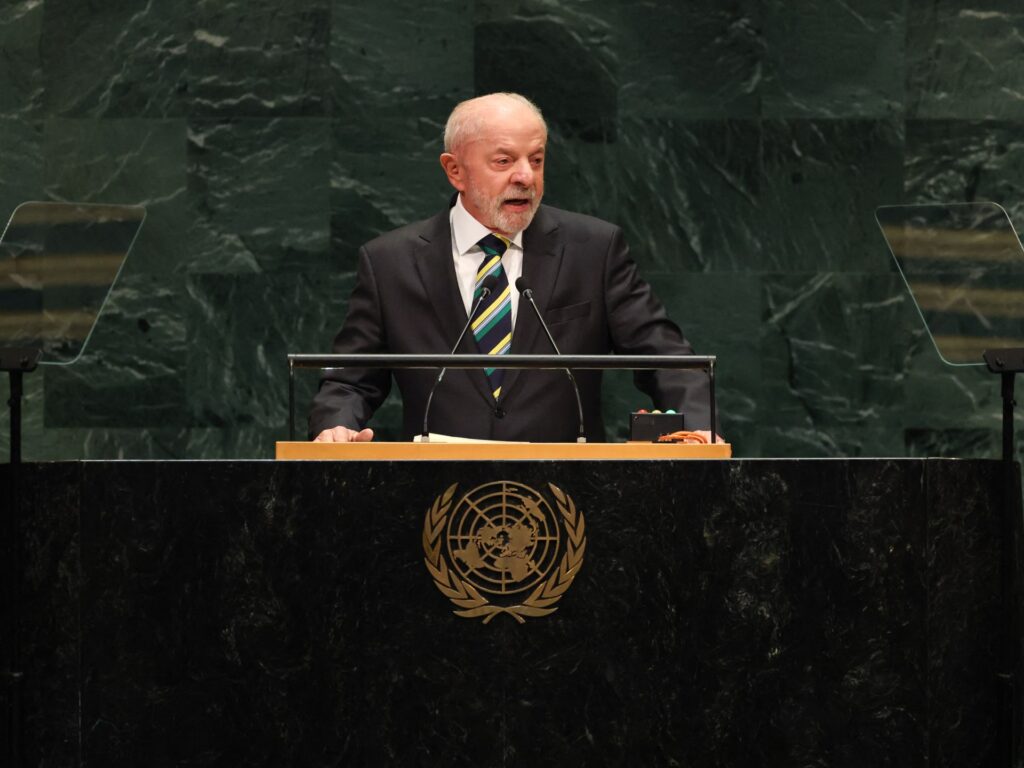
In a recent address at the United Nations, Brazilian President Luiz Inácio Lula da Silva made a strong statement defending Brazil’s sovereignty and warning against foreign interference in Latin American affairs. Lula’s remarks underscore his commitment to regional autonomy and a call for respect towards each nation’s self-determination.
During his speech, Lula emphasized the importance of Latin American countries shaping their own destinies without outside pressure or intervention. This message comes at a critical time as global powers, particularly the United States, have been vocal about their influence in the region.
President Lula said, “Brazil is not a playground for external powers. Our sovereignty must be respected, and our people must be free to direct their own futures without intrusion.”
This assertive stance contrasts sharply with comments from former US President Donald Trump, who also addressed the UN at the same session. Trump reiterated the United States’ commitment to maintaining influence and power in Latin America, asserting that it remains a key strategic region for the US.
Trump’s speech highlighted America’s role as a guarantor of security and economic stability across the hemisphere, often advocating for policies that critics argue could undermine Latin American nations’ autonomy.
Lula’s caution against foreign meddling resonates with many Latin American leaders, who have historically resisted external interventions aimed at political or economic control.
The Brazilian leader called for solidarity among Latin American countries to strengthen regional cooperation mechanisms and reduce dependence on traditional global powers. He also stressed the need for international respect towards Latin America’s diverse cultures, economic models, and political systems.
Analysts view Lula’s speech as part of a broader effort to reassert Brazil’s leadership role in Latin America, positioning it as a counterbalance to US dominance in the region. Brazil’s foreign policy under Lula has consistently favored multilateral partnerships and South-South cooperation.
The United Nations platform offered Lula an opportunity to articulate these views on the global stage, appealing to other nations to support Latin America’s quest for sovereignty and development.
In the context of recent geopolitical tensions, Lula’s remarks could signal a growing push within Latin America for a more independent and united front in international relations. The emphasis on sovereignty and non-interference aligns with longstanding principles enshrined in the UN Charter that seek to uphold the integrity of all member states.
Moreover, Lula’s position contrasts with more interventionist perspectives that have periodically influenced the region’s political landscape, causing economic disparities and social unrest.
The debate between Lula and Trump at the UN reflects wider global conversations about influence, power, and respect for national borders—issues that remain central to international diplomacy in the 21st century.
Looking ahead, Brazil under Lula is likely to continue advocating for Latin American interests at international forums, promoting peaceful cooperation and mutual respect among all nations.
This ongoing dialogue at the UN underscores the delicate balance between national sovereignty and global leadership, a challenge that will shape Latin America’s future as well as its relations with powerful countries like the United States.
In summary, Lula’s defense of Brazil’s sovereignty and condemnation of foreign interference mark a pivotal stance in Latin America’s international policy discourse. His comments serve as a bold rebuttal to former US President Trump’s assertions of power and influence in the region, highlighting contrasting visions for Latin America’s path forward on the world stage.