Hong Kong recently held a state funeral to honour Tung Chee-hwa, the city’s first post-colonial leader. Tung was selected by Beijing in 1996, a pivotal moment as Hong Kong was preparing for the historic handover from British to Chinese sovereignty in 1997. His leadership spanned some of the most turbulent political times in Hong Kong’s modern history, deeply influencing its trajectory.
Tung Chee-hwa’s tenure as the Chief Executive of Hong Kong began in 1997, marking a new chapter for the city after more than a century of British colonial rule. As the city’s first leader under Chinese administration, Tung faced immense challenges in steering the newly established Hong Kong Special Administrative Region (HKSAR) through the complex dynamics of integration with Mainland China while maintaining the region’s autonomy under the “one country, two systems” framework.
Throughout his leadership, Tung was at the center of numerous political and social challenges. His administration saw the aftermath of the 1997 Asian Financial Crisis, which severely impacted Hong Kong’s economy. Furthermore, his push for closer ties between Hong Kong and Mainland China, together with efforts to implement controversial legislation such as the Article 23 security law, sparked wide public debate and unrest.
Tung’s approach was sometimes met with criticism from various sectors of Hong Kong society, particularly pro-democracy advocates who questioned the pace and nature of political reforms under his administration. Despite these controversies, Tung was credited for stabilizing Hong Kong during the uncertain early years after the handover and laying foundations for the city’s return to Chinese rule.
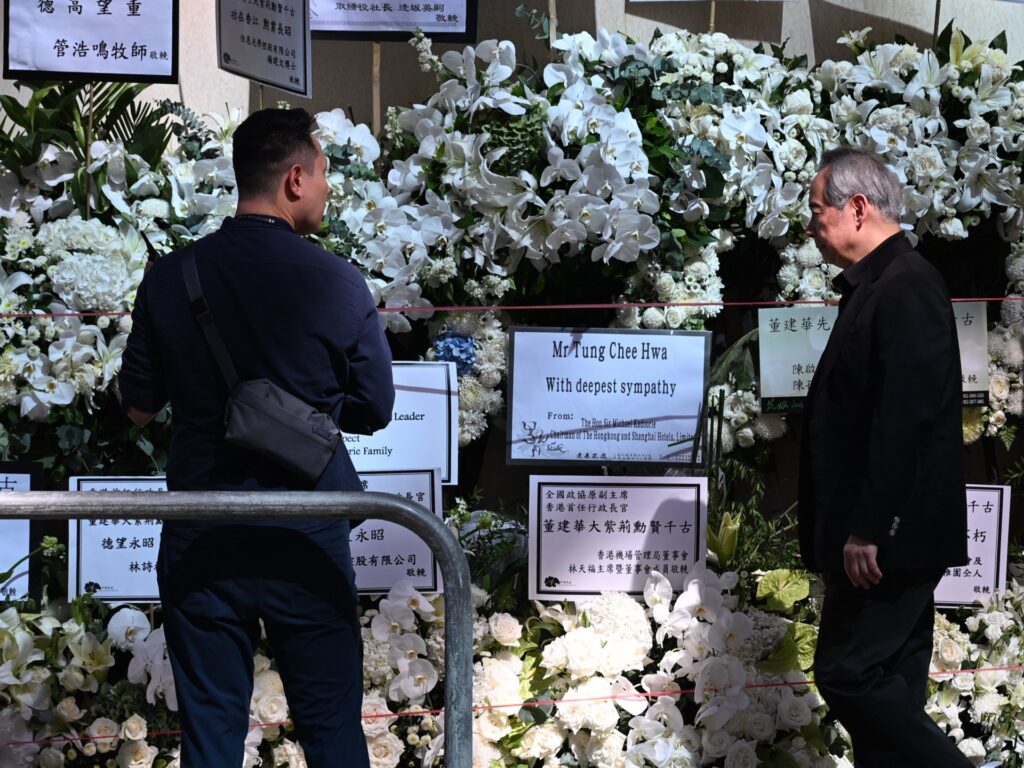
The state funeral held in Tung’s honour was attended by leading political figures from both Hong Kong and Mainland China, reflecting his significant role in shaping the city’s post-colonial identity. The ceremony was marked by official tributes and public condolences, recognizing Tung’s contributions to Hong Kong’s development and his complex legacy.
Experts note that Tung Chee-hwa’s time in office remains a defining era for Hong Kong, setting the stage for future political discourse and developments. His leadership style and policies continue to influence debates around Hong Kong’s governance, identity, and relationship with Mainland China.
As Hong Kong reflects on Tung Chee-hwa’s passing, the city acknowledges the intricate history of its transition from colony to Special Administrative Region and the leaders who navigated its path through uncertain and changing times. His death marks the end of a significant chapter in Hong Kong’s post-colonial history.
The funeral procession and memorials allowed Hong Kong citizens to pay respects and remember a figure who played an integral role in the city’s journey. It also reinforced the ongoing dialogue about Hong Kong’s future amid continuing political challenges. Tung Chee-hwa’s legacy, complex and multifaceted, remains central to understanding the city’s recent history.