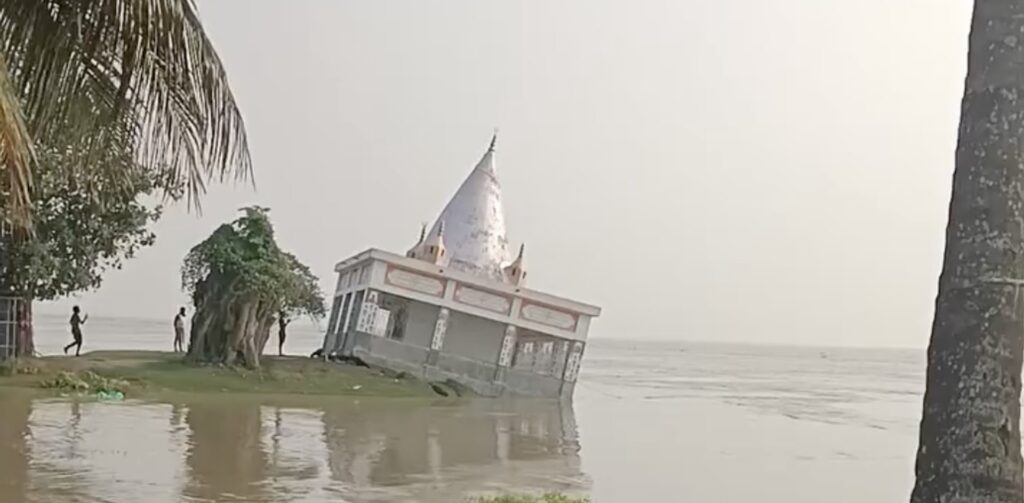
A significant cultural and religious loss was recently witnessed in West Bengal, India, as a historic Indian temple tragically collapsed into the Ganges River. The collapse occurred after the protective barriers along the riverbank were severely breached due to relentless erosion caused by the surging waters of the Ganges.
The temple, an important spiritual site for the local community, stood close to the riverbank, which subjected it to the impact of natural wear and tear over time. However, recent severe erosion intensified by monsoon rains and river currents weakened the embankments that once safeguarded the temple’s foundation.
Officials and local authorities had been monitoring the riverbank erosion for months, but the rapid and extensive damage came as a surprise, leading to this sudden and unfortunate loss. The protective barriers, which included stone walls and reinforced earth embankments, gave way, unleashing a swift surge of water that engulfed the temple premises.
Eyewitnesses reported seeing large portions of the temple structure crumble and submerge into the river waters. Rescue and response teams were immediately dispatched to the site to assess the situation, assist affected individuals, and secure the area. Fortunately, there were no reported casualties, but the symbolic and spiritual damage has deeply affected the local population.
The Ganges River, known as the lifeline of millions in India, has a complex interaction with the communities along its banks. While it provides vital resources, it also poses challenges such as flooding and erosion due to natural and human-made factors. Riverbank erosion is a persistent problem in many parts of West Bengal, threatening homes, agricultural land, and cultural landmarks.
Experts cite several reasons contributing to the escalating erosion along the Ganges. These include changing river flow patterns, deforestation upstream reducing soil stability, and silt deposition dynamics. Climate change has also played a role by altering precipitation patterns and intensifying rainfall events, accelerating the erosion processes.
In response to this incident, government agencies have promised to implement more robust flood and erosion control measures, including the reinforcement of embankments and the construction of new protective barriers. Efforts will also focus on sustainable river management to balance ecological, cultural, and community needs.
Local leaders and cultural preservationists are urging immediate measures to protect other vulnerable heritage sites from a similar fate. They emphasize the importance of preserving India’s rich historical and religious legacy, which is closely intertwined with the country’s natural environment.
Community members are also being engaged in riverbank conservation efforts through awareness campaigns and participation in afforestation projects aimed at stabilizing the soil and reducing erosion.
The temple collapse serves as a stark reminder of the delicate balance between nature and human heritage. It highlights the urgent need for coordinated action involving government bodies, environmentalists, and local populations to protect invaluable cultural landmarks threatened by natural disasters.
As investigations continue, authorities are documenting damage and planning for the temple’s restoration or relocation to ensure that its spiritual significance is not lost.
This event underscores the continuing challenges faced by many riverine communities across India, where traditional ways of life are increasingly jeopardized by environmental changes.
It also brings attention to the global issue of preserving cultural heritage sites in the face of climate change and natural hazards, calling for innovative solutions and international cooperation.
In conclusion, the collapse of the temple into the Ganges is a profound loss, echoing far beyond the riverside town. It prompts a renew focus on environmental stewardship, cultural preservation, community resilience, and the intricate relationship between people and their landscapes in India and beyond.