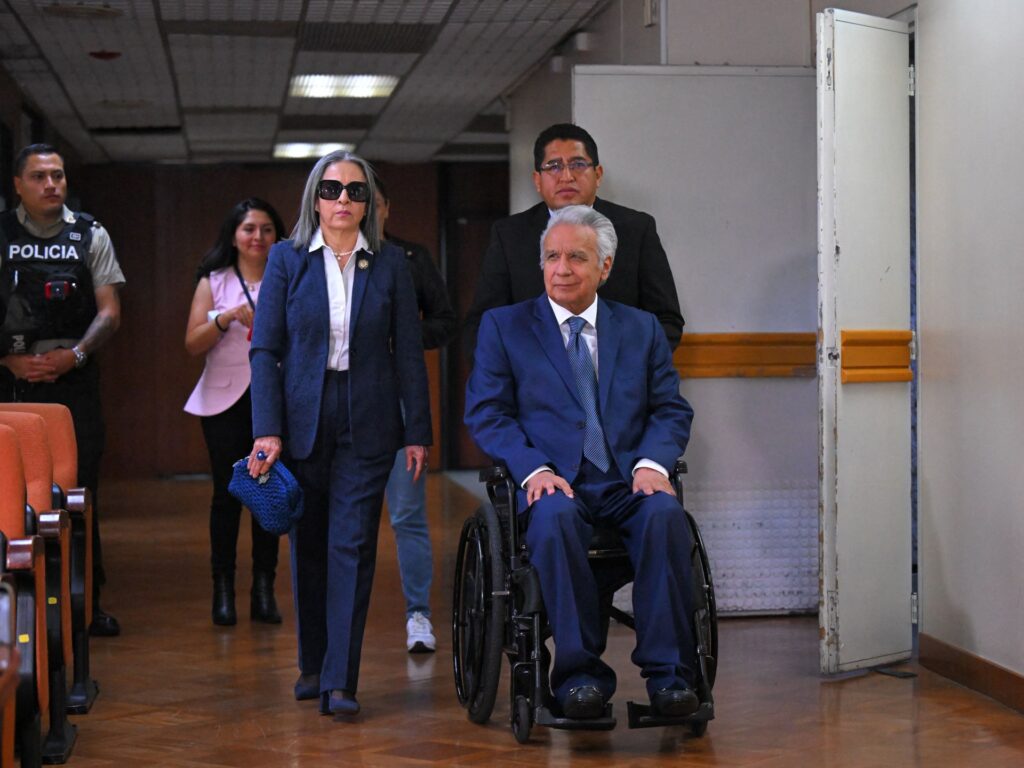
In a landmark judicial decision, Ecuador has sentenced former President Lenin Moreno to five years in jail after finding him guilty in a bribery case. The court’s verdict came after an extensive investigation into allegations that Moreno was involved in illicit activities during his tenure as president. In addition to the prison sentence, Moreno, aged 73, has been permanently barred from holding any public office in the future, marking a significant fall from grace for the once influential political leader.
Lenin Moreno, who served as Ecuador’s president from 2017 to 2021, had been under scrutiny for various corruption allegations following his departure from office. The bribery case centered around accusations that he accepted kickbacks in exchange for government contracts, a charge that the court found substantiated based on the evidence presented.
The trial attracted widespread media attention and was seen as a critical moment in Ecuador’s ongoing efforts to combat corruption at the highest levels of government. Transparency advocates hailed the ruling as a victory for justice and a clear message that no individual, regardless of their position, is above the law.
This development has sent shockwaves through Ecuador’s political landscape, where corruption has been a persistent issue undermining public trust in government institutions. Moreno’s conviction is one of the most high-profile cases to emerge in recent years, reflecting a growing commitment by Ecuadorian authorities to hold former officials accountable.
Political analysts suggest that the sentencing could have far-reaching implications for Ecuador’s political climate, potentially influencing upcoming elections and reforms aimed at strengthening governance and accountability.
Moreno’s supporters have expressed disappointment and concern over the verdict, arguing that the case was politically motivated. However, the judiciary has maintained that the decision was based solely on the rigorous evaluation of evidence and adherence to legal procedures.
The Ecuadorian government has reaffirmed its dedication to transparency and the rule of law, emphasizing that this case exemplifies their zero-tolerance policy toward corruption. International observers have also noted the significance of the ruling as part of broader efforts in Latin America to address corruption challenges.
Lenin Moreno’s sentence serves as a reminder of the ongoing struggles in many countries to balance political power with accountability. The outcome of this case is likely to influence public perceptions and governmental practices moving forward, reinforcing the importance of integrity in public service.
As Moreno begins serving his sentence, the attention now turns to how Ecuador will continue to strengthen its institutional frameworks to prevent similar abuses of power in the future. The case stands as a pivotal moment in Ecuador’s democratic history and a significant step in the fight against corruption.