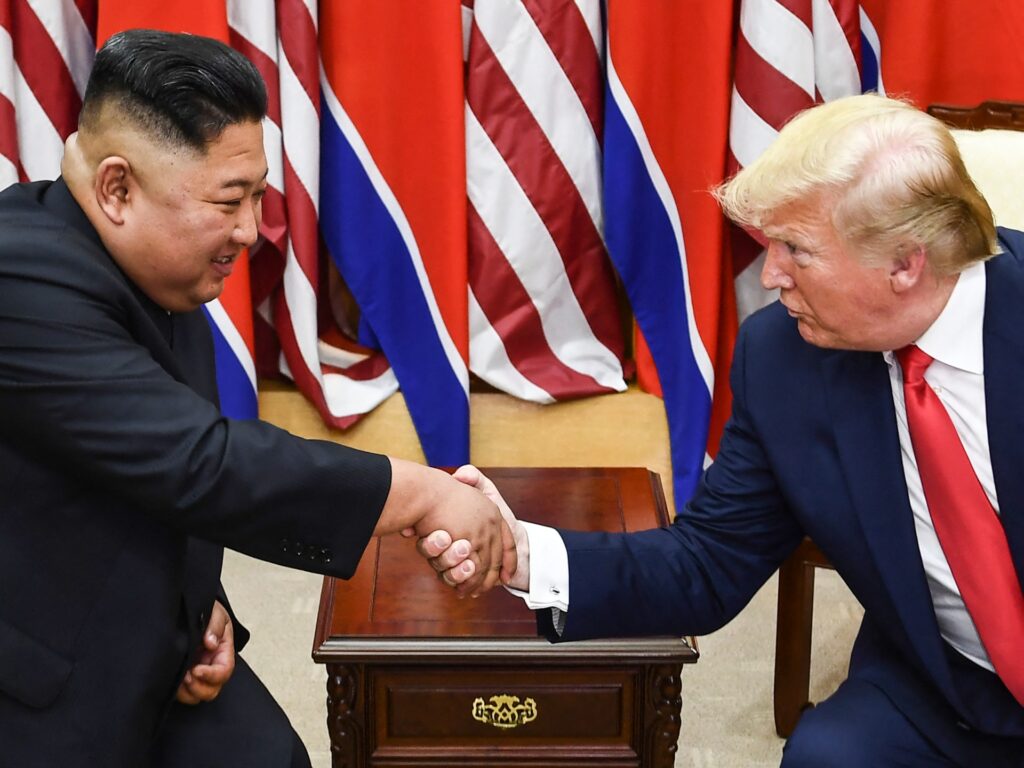
Former U.S. President Donald Trump has recently resumed efforts to improve relations with North Korean leader Kim Jong Un, stirring discussions among political analysts and international observers. This move, deemed a strategic ‘tit for tat,’ appears to be motivated by intricate political signals directed at both Pyongyang and Seoul.
During his presidency, Trump took an unorthodox approach towards North Korea, marked by historic summits with Kim Jong Un. However, despite initial enthusiasm, these engagements ultimately failed to yield lasting denuclearization agreements. Now, as Trump signals a renewed interest in diplomacy, experts suggest his motives are multifaceted.
Analysts highlight that Trump’s renewed outreach serves as a political message to North Korea, aimed at reestablishing influence in the volatile region amid evolving geopolitical dynamics. This gesture could be interpreted as a way to reinsert U.S. presence and interests in discussions with Pyongyang, emphasizing a stance of engagement rather than isolation.
Simultaneously, Trump’s approach sends a subtle signal to South Korea. By engaging directly with Kim, he underscores the importance of the U.S.-South Korea alliance while also reminding Seoul of the value and leverage the United States holds in the peninsula’s security framework.
The timing of this diplomatic overture is significant. North Korea has intensified its missile tests recently, raising alarms in the international community. Trump’s outreach could be an attempt to temper tensions and present himself as a key intermediary able to navigate complex relations with Pyongyang.
Moreover, some political commentators believe Trump’s actions are domestically motivated, aiming to bolster his image as a decisive leader in international affairs ahead of potential future political campaigns. By reengaging with North Korea, Trump revitalizes a narrative of bold negotiation and breaking conventional diplomatic molds.
Critics, however, caution against overestimating the impact of Trump’s diplomacy. They argue that without substantial policy shifts or reciprocal commitments from North Korea, these efforts may amount to little more than symbolic gestures.
Nonetheless, this renewed ‘tit for tat’ engagement highlights the delicate balance of power and diplomacy in Northeast Asia. It reflects ongoing challenges in managing North Korea’s ambitions while supporting regional stability through complex international alliances.
As Trump cosies up to Kim Jong Un once again, the world watches closely to see whether this approach will herald a thaw in relations or merely stage another episode in a long-standing geopolitical saga.