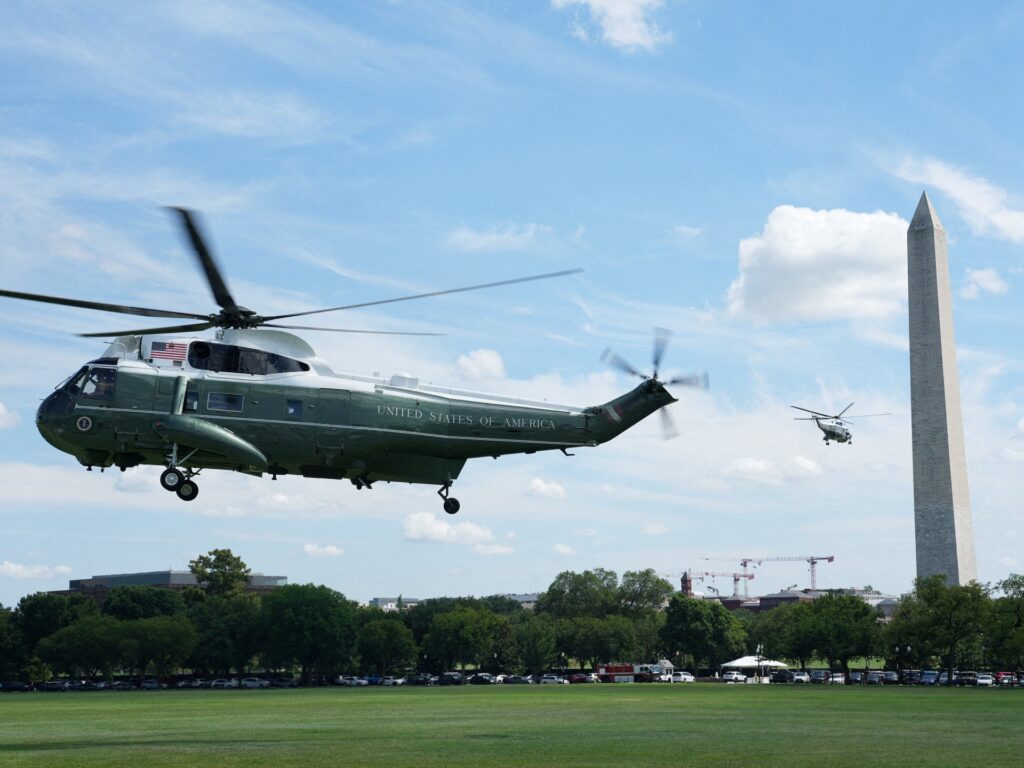
The Federal Aviation Administration (FAA) has revealed that former President Donald Trump’s Marine One helicopter briefly flew dangerously close to a commercial passenger jet during a recent departure. This unexpected proximity raised immediate safety concerns and prompted an internal review of the incident.
According to sources familiar with the event, the main issue stemmed from a failure by air traffic controllers to temporarily halt commercial flights while Marine One was taking off. Normally, such procedures are rigorously followed to ensure that presidential aircraft can depart and arrive without interference or risk from nearby air traffic.
Marine One, the call sign for any United States Marine Corps aircraft carrying the President, operates under stringent security protocols including restricted airspace and coordinated flight plans to guarantee the utmost safety. In this instance, the lapse in coordination led to the helicopter encroaching into an area where a passenger jet was also navigating, elevating the risk of a midair conflict.
The FAA has not disclosed specific details about the types of aircraft involved or the exact location of the incident. However, the agency confirmed that they immediately started an investigation to understand how the oversight occurred and to implement measures to prevent future occurrences.
Aviation safety experts emphasize that such incidents, while rare, underscore the critical importance of precise communication and execution in air traffic management, especially in congested airspace around major airports where both commercial and government flights operate concurrently.
This event highlights the challenges faced by air traffic controllers tasked with maintaining safety for diverse air traffic, balancing routine commercial operations with special flights like those carrying the president. Enhanced training and updated protocols may be considered in light of this event to reinforce safety boundaries and improve situational awareness.
The FAA’s investigation will likely review air traffic control recordings, communication logs, and radar data to determine the sequence of events and any systemic lapses. Additionally, it will involve consultations with Marine One’s flight operations team to coordinate better future departures.
Officials assure the public that despite the close call, there was no accident or damage reported, and the safety of passengers and crew remains the highest priority. The FAA also stated its commitment to transparency and will provide updates as the investigation progresses.
This incident serves as a reminder of the complex and dynamic nature of managing the nation’s skies, especially when high-profile flights intersect with everyday commercial air traffic. It also invites renewed attention to aviation safety protocols and the vital role of air traffic controllers in safeguarding all who take to the skies.