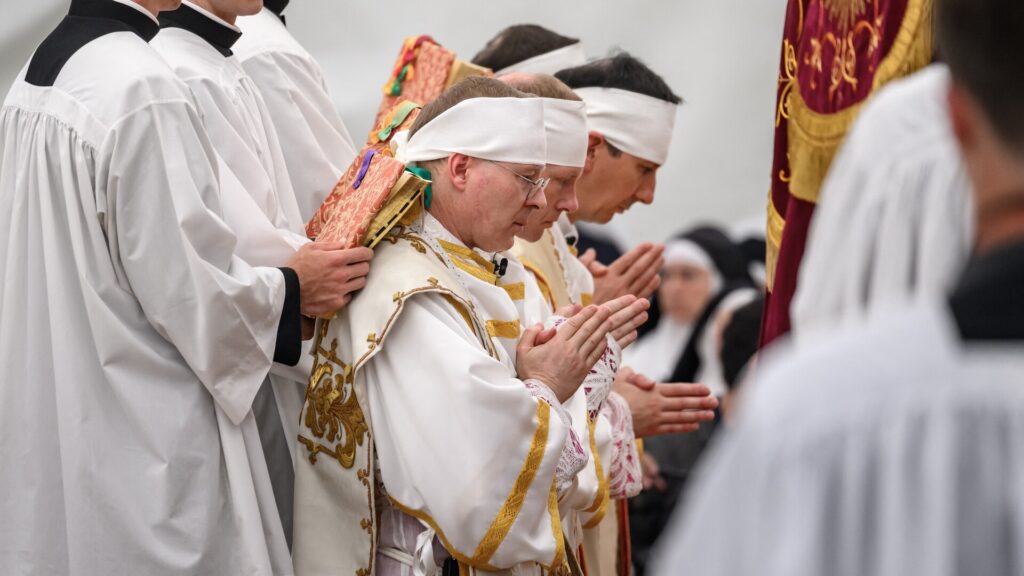
Consacred bishops are seen during the schismatic consecration of bishops by the traditionalist Catholic Society of Saint Pius X (SSPX) in Econe, western Switzerland, on July 1, 2026. On June 30, 2026, Pope Leo XIV urged the Society to abandon its plan to ordain bishops without Vatican approval, warning it would lead to automatic excommunication. Founded in 1970 in Econe by French bishop Marcel Lefebvre, the Society of Saint Pius X categorically rejects the changes in the Church since the Second Vatican Council. (Photo by Fabrice COFFRINI / AFP)
A significant and unprecedented schism has emerged within the Roman Catholic Church as a group of rogue bishops openly defies the authority of Pope Leo XIV and the Vatican. This rebel faction, comprised of several ordained bishops, has taken the controversial step of ordaining their own bishops without Vatican approval, directly challenging the Church’s hierarchical and canonical structure.
The emergence of these rogue bishops signals a profound crisis within the Church, raising complex theological, canonical, and political questions. Ordinarily, the ordination of bishops is a tightly controlled process overseen by the Vatican to maintain doctrinal unity and ecclesiastical order. By circumventing this process, the rebel group not only questions the central authority of the Pope but also risks deepening internal divisions among Roman Catholics worldwide.
Details about the identities of these rogue bishops remain somewhat obscure, as the group operates covertly, seeking to avoid immediate suppression by Vatican authorities. However, reports suggest that they are driven by disagreements with certain Vatican policies and doctrinal teachings promulgated by Pope Leo XIV. By ordaining their own bishops, they aim to assert a parallel ecclesiastical authority and provide an alternative leadership structure for those dissatisfied with the current papacy.
The Vatican has responded firmly, condemning these ordinations as illicit and invalid under Church law. Pope Leo XIV has reiterated his commitment to preserving the unity and sanctity of the Catholic Church, emphasizing that any attempt to undermine papal authority threatens the spiritual well-being of the faithful and the Church’s global mission.
This rebellion recalls historical schisms where factions within Christianity broke away over doctrinal or leadership disputes, leading to long-lasting fractures. The modern Church has faced numerous challenges before, but the ordination of unauthorized bishops within its own ranks presents a particularly dangerous form of dissent.
Experts in Church history and canon law note that reconciliation and dialogue remain crucial to resolving this crisis, to avoid a potential formal schism. They observe that the Church’s resilience depends on its ability to address grievances within its framework rather than through defiance.
For the Catholic faithful worldwide, this development is both troubling and confusing, as they look for guidance amid uncertainty. Many hope the situation can be peacefully resolved to maintain the Church’s unity and continue its spiritual mission without division.
As the situation develops, all eyes remain on Pope Leo XIV and the Vatican’s response to this extraordinary challenge. The coming weeks and months will likely shape the future direction of the Church and its leadership structure, testing its ability to uphold tradition while navigating internal dissent.