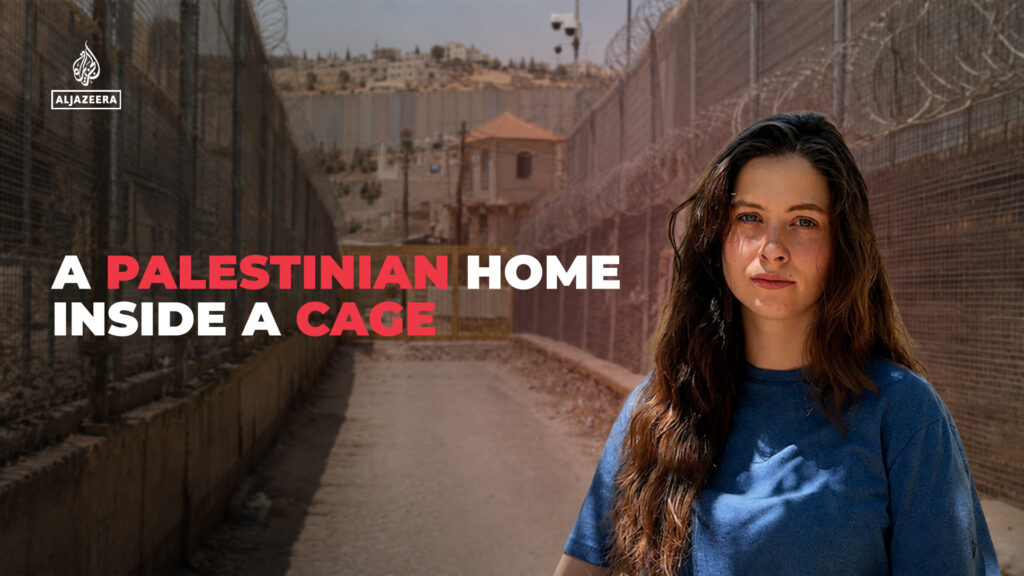
In the complex landscape of the Israeli-Palestinian conflict, a poignant symbol of hardship emerges in the form of a Palestinian family’s home enclosed within an Israeli settlement and the separation wall. Al Jazeera’s Leila Warah brings to light the daily realities faced by this family, offering a vivid glimpse into the impact of ongoing geopolitical tensions on ordinary lives.
This unique situation exemplifies the broader challenges Palestinians encounter in the occupied territories. The family’s house is physically sealed off by the encroachment of an Israeli settlement on one side and the formidable separation wall on the other. This creates an enclave-like circumstance, effectively isolating them from their community and access to essential services and social interaction.
The separation wall, constructed by Israel starting in the early 2000s, was officially described as a security barrier. However, its trajectory has often cut deep into Palestinian lands, severing villages and disrupting livelihoods. For this family, the wall’s encirclement of their home symbolizes the tangible limitations imposed on movement and freedom.
Living “inside a cage” means coping with restricted access to schools, healthcare, employment, and markets. The family’s children face difficulties attending school regularly, while adults confront obstacles to maintaining traditional sources of income and farming activities. Limited mobility also complicates medical emergencies and social connections.
The psychological toll is substantial. The sense of confinement fosters feelings of isolation, frustration, and uncertainty, particularly among the younger generation who see their futures constrained by geographical and political boundaries beyond their control.
Local and international human rights groups have frequently criticized the expansion of Israeli settlements and the consequences of the separation barrier. They argue that such measures violate international law and infringe on Palestinians’ right to self-determination.
The Israeli authorities defend the wall and settlements on security grounds, citing protection against attacks. Yet, critics contend that the prolonged occupation and land appropriation amount to de facto annexation, undermining prospects for peace and a two-state solution.
This particular family’s ordeal has drawn media attention as a microcosm of the conflict’s human dimension. Their experience underscores the urgent need for renewed diplomatic efforts aimed at addressing the political impasse and fostering coexistence.
The situation also highlights the resilience and dignity of Palestinians living under increasingly restrictive conditions. Despite the harsh environment, the family maintains a hopeful outlook, nurturing aspirations for freedom, stability, and normalcy.
Leila Warah’s reporting sheds light on the nuanced realities often obscured by headlines focused on violence or political rhetoric. By sharing this personal story, the coverage invites the world to engage more deeply with the persistent humanitarian consequences of the Israeli-Palestinian conflict.
As negotiations and international interventions continue with varying degrees of success, the plight of families like this one remains a compelling reminder of the stakes involved. Their home, trapped in a cage of walls and settlements, serves as a stark metaphor for the restrictions faced by millions of Palestinians living in occupied territories.
The hope persists that one day, these walls will no longer divide, and families will live free from encirclement—embracing a future where peace and justice prevail in the region.