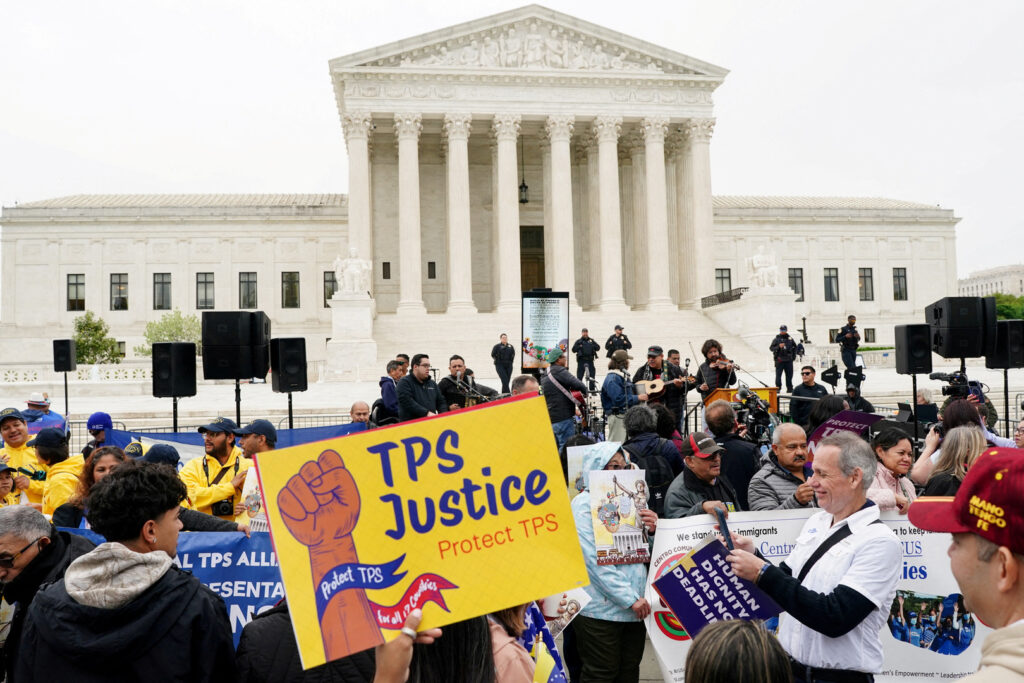
FILE PHOTO: Immigrants' rights activists and demonstrators attend a rally outside the U.S. Supreme Court, as justices were scheduled to hear arguments on whether the administration of U.S. President Donald Trump can end the Temporary Protected Status (TPS) of Syrian and Haitian nationals, in Washington, D.C., U.S., April 29, 2026. REUTERS/Nathan Howard/File Photo
The United States Supreme Court has made a pivotal ruling that ends Temporary Protected Status (TPS) protections for Haitian and Syrian nationals. This decision aligns with the Trump administration’s efforts to terminate TPS designations for these groups. TPS is a humanitarian program that grants temporary relief from deportation and work authorization to immigrants from countries experiencing ongoing armed conflict, environmental disasters, or other extraordinary conditions. Haitians and Syrians have relied on TPS for many years due to crises in their home countries—Haiti suffering from devastating earthquakes and political instability, and Syria enduring a protracted civil war. The Supreme Court ruling recognizes the government’s authority to conclude TPS designations, stating that the protections are temporary and contingent upon specific country conditions. The termination of TPS means that thousands of Haitian and Syrian nationals currently residing in the US under this status face potential deportation unless they qualify for other immigration relief. Supporters of the ruling argue that TPS is an emergency measure and that permanent residency solutions must go through formal immigration processes. Critics, however, stress that ending TPS prematurely disregards ongoing dangers and humanitarian concerns in the affected countries, potentially putting vulnerable populations at risk. The decision is expected to prompt intense debates in Congress about how to address the status of these immigrants and whether to create pathways to permanent residency. Advocacy groups warn of increased hardship for individuals and families with deep ties to US communities. Since its inception, TPS has provided protection to hundreds of thousands who fled crises abroad, offering them safety and stability during times of turmoil. The Supreme Court judgment underscores the complexity of balancing immigration control with humanitarian aid. For Haitians, the ruling comes amid continued recovery from past natural disasters and socio-political challenges, while Syrians face ongoing conflict and displacement issues. Efforts are underway among lawmakers, advocacy organizations, and affected communities to find legislative solutions to protect those impacted by the TPS termination. The decision highlights the broader immigration policy debates that have become central in US politics, where humanitarian concerns often intersect with national security and legal frameworks. Moving forward, the government and civil society groups will need to collaborate on strategies to mitigate the impact on TPS recipients while respecting the rule of law. As the TPS program winds down for Haitians and Syrians, many immigrants face uncertainty about their future in the US, including the risk of deportation and family separations. This ruling marks a significant shift in US immigration policy, reflecting a stricter approach to temporary humanitarian protections. The Supreme Court’s decision is a reminder of the impermanence of such status designations and the legal challenges immigrants face in navigating US immigration systems. Ultimately, the debate over TPS termination brings to light the ongoing tension between compassion for displaced populations and the enforcement of immigration laws. In the coming months, the implications for Haitian and Syrian communities in the US will become more evident as the government implements its new policy directives following this landmark decision.