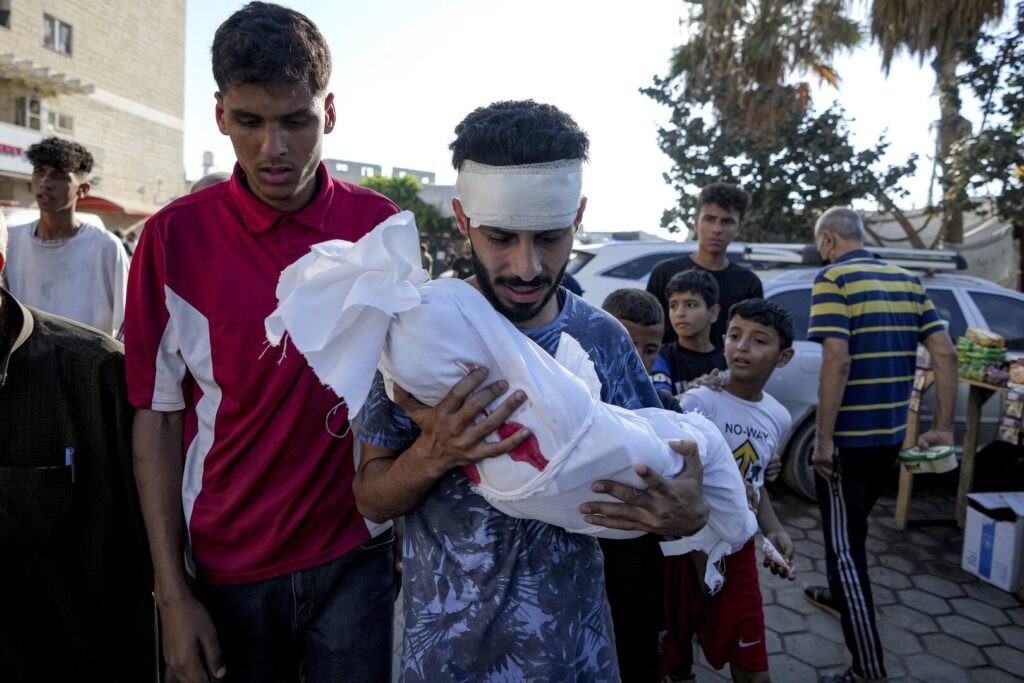
A relative holds the body of a child killed in the Israeli bombardment of the Gaza Strip, at a hospital morgue in Deir al-Balah, Tuesday, July 16, 2024. (AP Photo/Abdel Kareem Hana)
Recent reports and statements from United Nations officials have accused Israel of committing acts of genocide against Palestinian children in Gaza. According to these allegations, Israeli military operations have deliberately targeted children, resulting in substantial loss of young lives within the region.
This accusation stems from detailed investigations and observations by UN human rights bodies and independent observers. Their findings indicate that the Israeli military’s tactics in Gaza have not only resulted in excessive civilian casualties but appear to specifically affect vulnerable populations, particularly children.
The situation in Gaza has long been a subject of international concern, with ongoing conflicts between Israel and Palestinian groups leading to repeated outbreaks of violence. However, the explicit targeting of children as suggested by UN reports marks a grievous intensification of hostilities and raises profound questions about adherence to international humanitarian law.
Experts in international law emphasize that genocide is defined as acts committed with intent to destroy, in whole or in part, a national, ethnical, racial, or religious group. The reported evidence pointing to the intentional targeting of Gaza’s children aligns with this definition, sparking urgent calls for accountability and intervention.
The UN’s statements have further propelled the international community to reevaluate the conflict dynamics in Gaza. Human rights organizations worldwide have echoed these concerns, underscoring the necessity of protecting civilians, especially children, in conflict zones.
Israeli authorities have consistently denied any intent to target civilians and assert that military actions are directed at militant groups operating within Gaza. They argue that civilian casualties, while tragic, are unintended consequences of legitimate self-defense measures.
Nonetheless, the UN’s grave accusations have intensified diplomatic pressures on Israel to cease operations that harm civilians and to engage in more robust dialogues toward peace.
The impact of this conflict on Gaza’s children is devastating. Beyond loss of life, children face severe psychological trauma, disruption of education, and the destruction of their communities.
International response to these developments includes calls for independent investigations to thoroughly examine the UN’s claims, humanitarian aid to support affected families, and renewed efforts to negotiate a lasting ceasefire.
The situation remains volatile, with many urging global powers to increase their mediation efforts to prevent further escalation.
This unprecedented labeling of Israel’s actions as genocide by the UN marks a critical juncture in the Gaza conflict. It demands a rigorous and transparent response to uphold human rights and ensure justice for the victims.
Efforts to safeguard Palestinian children in Gaza must become a priority in international policy discussions and peace initiatives.
As the world watches closely, the humanitarian and political ramifications of these allegations could influence future interactions and policies between Israel, Palestine, and the global community.
The international community is called to action, recognizing that the protection of children in conflict zones is a moral imperative and a cornerstone of global peace and security.