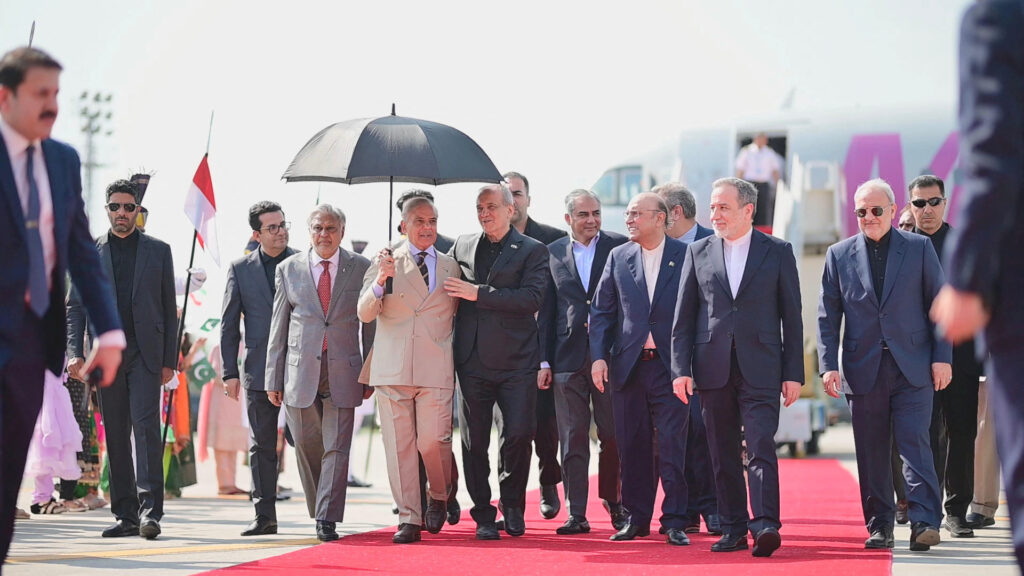
President of Iran Masoud Pezeshkian is received by Pakistan's Prime Minister Shehbaz Sharif and President Asif Ali Zardari upon his arrival at Nur Khan Airbase in Rawalpindi, Pakistan, June 23, 2026. External Publicity Wing (EPW)/Handout via REUTERS ATTENTION EDITORS - THIS PICTURE WAS PROVIDED BY A THIRD PARTY. NO RESALES. NO ARCHIVES.
Iran’s President landed in Pakistan to engage in critical peace talks aimed at strengthening bilateral relations and regional stability. The visit underscores the importance of cooperation between the two neighboring countries amidst complex geopolitical dynamics in the region.
Upon arrival, the president was welcomed by top Pakistani officials. The discussions are expected to cover a spectrum of issues including border security, economic collaboration, and counter-terrorism efforts. Both nations share a common goal of fostering peace and addressing shared challenges such as extremism and economic development.
This diplomatic visit comes at a crucial time when regional tensions have been fluctuating, and there is a concerted push for dialogue and peaceful resolutions. Leaders from both Iran and Pakistan have expressed optimism that these talks will pave the way for enhanced cooperation on multiple fronts.
Economic ties are a key focus of the talks, with both countries eager to expand trade and investment opportunities. Iran’s strategic location offers Pakistan access to new trade routes, while Pakistan’s large market presents opportunities for Iranian goods and services.
Security cooperation is another critical component. Both nations face common threats from militant groups operating near their borders. Collaborative efforts to curb terrorism and improve border management are expected to be a priority in the discussions.
Cultural and social exchanges are also anticipated to be on the agenda, fostering greater understanding and goodwill between the peoples of Iran and Pakistan.
Overall, the visit marks a significant step towards regional cooperation and peacebuilding efforts. It highlights the mutual desire to address regional challenges through dialogue, partnership, and sustained diplomatic engagement.
As the talks progress, the international community watches closely, hopeful that the Iran-Pakistan initiative may serve as a model for resolving conflicts through diplomacy rather than confrontation. The success of these talks could not only stabilize the immediate region but also contribute to broader peace efforts across Southwest Asia.
In conclusion, Iran’s president’s visit to Pakistan for peace talks is a pivotal moment, promising new avenues for collaboration and a commitment to regional peace. The outcomes of these discussions have the potential to shape the geopolitical landscape and advance the cause of stability and prosperity in the region.