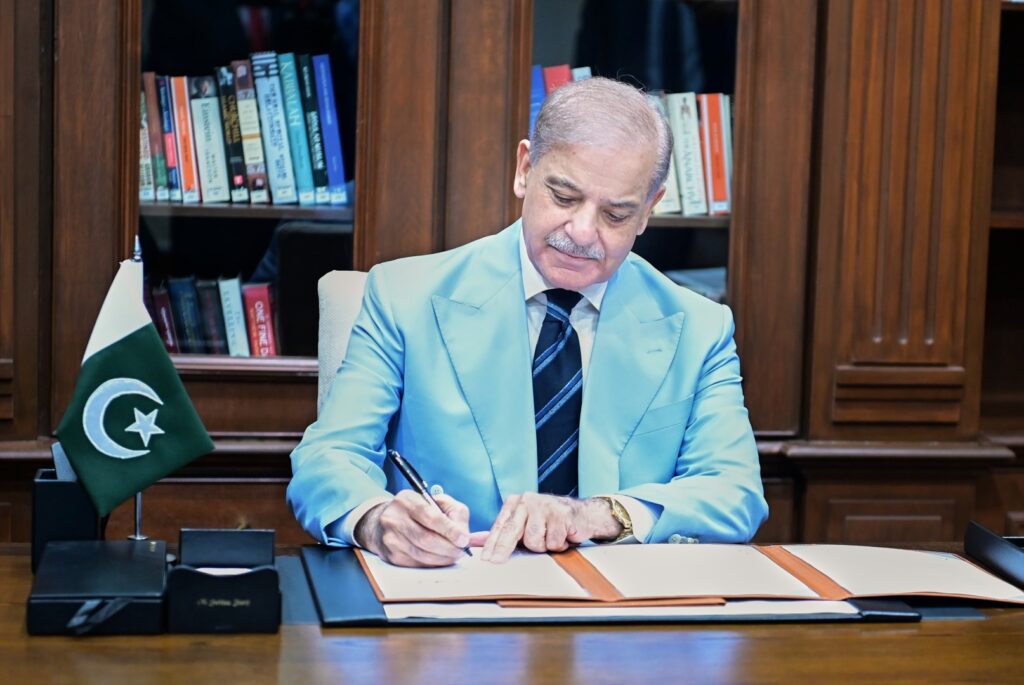
In this photo released by the Pakistan Prime Minister Office, Prime Minister Shehbaz Sharif in Islamabad, Pakistan, signs as mediator on a paper which the office said was a copy of the initial deal reached by the United States and Iran to end their war Thursday, June 18, 2026. (Pakistan Prime Minister Office via AP)
In a significant diplomatic development, Pakistan’s Prime Minister Shehbaz Sharif has signed a memorandum of understanding (MoU) between the United States and Iran, aiming to bring an end to ongoing hostilities. This MoU marks a hopeful step towards peace amidst years of tension and conflict in the region.
The agreement, brokered with Pakistan’s active involvement, signals a new chapter in US-Iran relations, long characterized by mistrust and volatility. Pakistan’s unique geopolitical position and longstanding ties with both countries have positioned it as an important mediator, facilitating dialogue and negotiations.
Prime Minister Shehbaz Sharif emphasized the importance of peace and stability not only for the involved nations but also for the broader international community. He stated that Pakistan is committed to promoting diplomatic solutions and fostering mutual understanding to resolve conflicts.
The MoU outlines a framework for dialogue, reduction of hostilities, and cooperation on security and economic issues. Both the US and Iran have agreed to engage in discussions to address contentious issues including sanctions, nuclear concerns, and regional security dynamics.
International observers have welcomed the initiative, expressing hope that it could pave the way for a durable peace agreement. Analysts note that Pakistan’s involvement reflects its growing role in regional diplomacy and its strategic desire to contribute to a stable South Asia and Middle East.
The MoU signing occurred during a high-profile ceremony attended by diplomatic representatives from multiple countries, underscoring the global significance of this breakthrough. It is expected that follow-up meetings and negotiations will take place in the coming weeks to operationalize the MoU’s provisions.
This development is likely to have profound implications for international relations, trade, and security. Stability in US-Iran relations could lead to eased sanctions, increased economic cooperation, and a reduction in proxy conflicts that have destabilized the region.
Pakistan’s Prime Minister Shehbaz Sharif has garnered praise for his diplomatic efforts, illustrating the critical role of intermediary nations in peace processes. His government has reiterated its commitment to facilitating further peace talks and supporting sustained dialogue.
The historic signing signals optimism for a future marked by dialogue rather than conflict, with Pakistan emerging as a key player in fostering peace between major powers. The international community now watches closely as the promises of the MoU are tested through real-world implementation and continued diplomatic engagement.