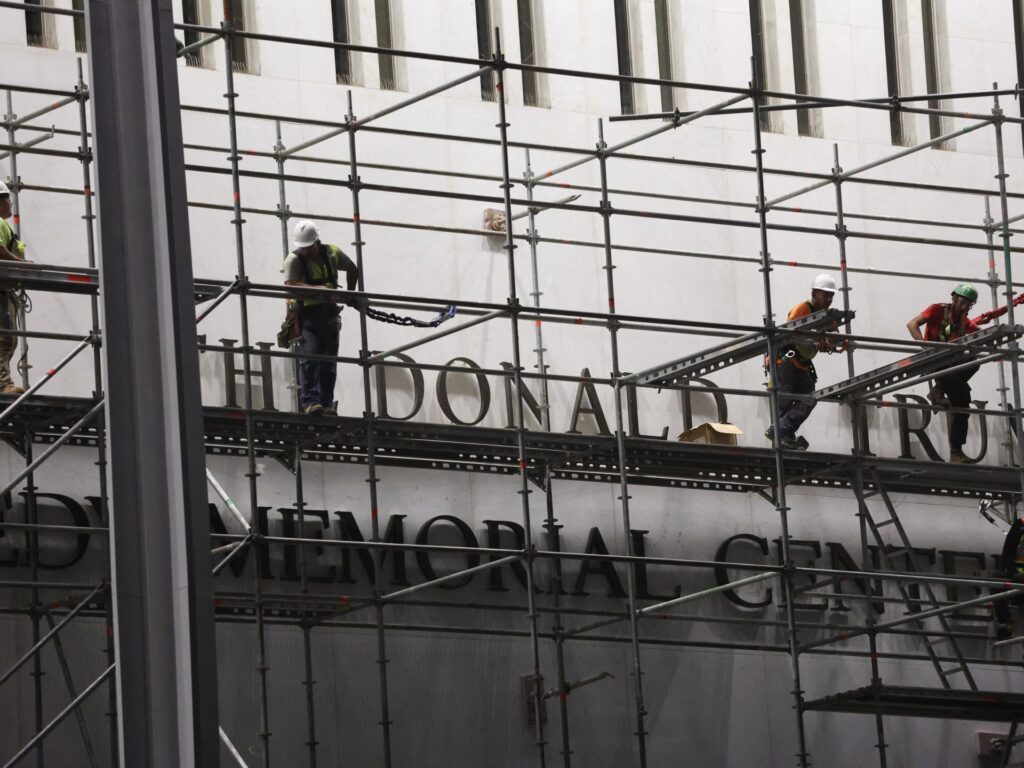
In a significant legal and cultural development, workers have begun removing the name of former President Donald Trump from the Kennedy Center. This action follows a court ruling that deemed the Trump-backed board’s decision to add the president’s name to the center unlawful. The court highlighted that such a move requires explicit Congressional approval, which was not obtained in this case.
The Kennedy Center, a prestigious cultural venue dedicated to the performing arts, had recently undergone a controversial renaming initiative led by a board supported by President Trump. The board had voted to include Trump’s name on the center, sparking debate and legal challenges from various stakeholders who argued that proper procedures and authorizations were not followed.
The judge’s ruling emphasized the importance of adhering to legal frameworks and Congressional oversight in decisions involving national institutions. According to the ruling, the board overstepped its authority by unilaterally adding the former president’s name without securing the necessary consent from Congress.
Following the ruling, the Kennedy Center has moved quickly to comply with the court’s decision. Workers have been dispatched to remove signage and other markers bearing Trump’s name. This reversal has been met with a mix of reactions from the public and political figures alike.
Advocates for the removal have expressed relief and satisfaction, viewing the court’s decision as a reaffirmation of legal protocols and the non-partisan nature of national cultural institutions. They argue that naming rights for such significant venues should be handled with transparency and bipartisan agreement.
Conversely, supporters of the former president have criticized the ruling as politically motivated, arguing that the board’s initial decision reflected the desires of certain stakeholders and should have been respected. They contend that the move to remove his name undermines efforts to recognize his administration’s contributions.
The Kennedy Center, funded in part by federal government appropriations, operates under guidelines that require Congressional approval for major naming decisions. This framework is intended to ensure that such decisions reflect national consensus rather than unilateral actions.
The case has set a legal precedent regarding the governance of national landmarks and the limits of authority for boards managing public institutions. Legal experts suggest that this ruling reinforces the checks and balances embedded in the oversight of federal cultural entities.
In the wake of the court order, the Kennedy Center’s leadership has pledged to review its policies on naming rights to prevent similar disputes in the future. They have committed to engaging with Congress and the public to establish clear and transparent procedures.
This episode highlights the complexities at the intersection of culture, politics, and law in the United States. It underscores the necessity for national institutions to maintain impartiality and adherence to legal processes to preserve their integrity and public trust.
As the removal continues, attention now turns to how the Kennedy Center will move forward, including potential Congressional discussions on how best to handle naming rights and honorifics in a way that respects both the institution’s heritage and the rule of law.