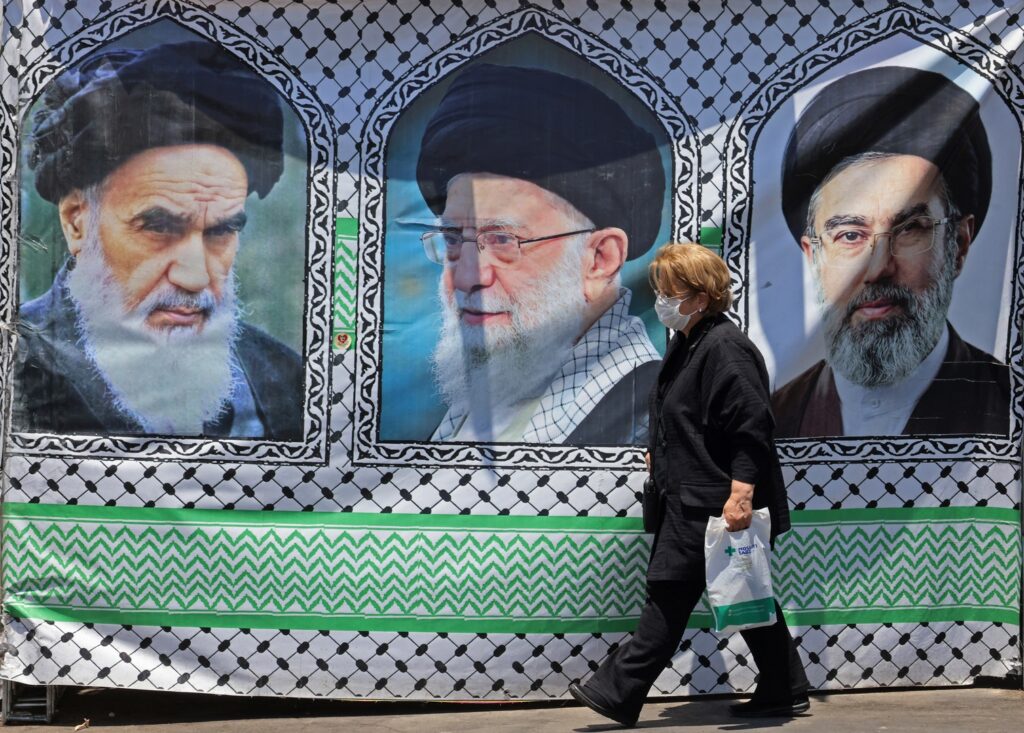
A woman walks past a banner bearing the images of the late founder of the Islamic Revolution supreme leader Ayatollah Ruhollah Khomeini (L), the late Iranian supreme leader Ali Khamenei and his son, the current supreme leader Mojtaba Khamenei (R), erected along a street at the Vanak Square in Tehran on June 10, 2026. Iran's foreign ministry said on June 10 that the United States had damaged the ongoing international diplomatic effort to end the war, after more US strikes on targets in southern Iran. (Photo by ATTA KENARE / AFP) /
Recently, Pakistan has emerged as a significant diplomatic player indicating that a final peace deal text has been agreed between the United States and Iran, with only the next steps left to finalize. This development raises important questions about Pakistan’s potential role in concluding the negotiations and the implications for regional stability.
The talks between the US and Iran have been long and complex, shaped by years of tension over Iran’s nuclear program, sanctions, and broader geopolitical rivalry. While earlier rounds of discussions made some progress, reaching a definitive agreement remained elusive.
According to sources within Pakistan’s diplomatic circles, much of the substantive groundwork has already been laid out in a draft of the peace deal, covering key contentious issues including limitations on Iran’s nuclear activities and sanction relief mechanisms. The Pakistani government suggests that the primary obstacles now pertain to procedural and implementation details that require careful sequencing.
Pakistan’s strategic position in South Asia, its historical ties with Iran, and its simultaneously complicated but ongoing relationship with the US, uniquely place it as a potential mediator who can help bridge gaps and build mutual confidence between the two countries. Islamabad has reportedly offered to facilitate dialogue and ensure the smooth transition from agreement text to enforceable commitments.
Experts note that Pakistan’s involvement brings both opportunities and challenges. On the positive side, Pakistan’s approach is often seen as pragmatic and conciliatory which could help de-escalate tensions and allow both sides to save face. Furthermore, Pakistan’s efforts may incentivize broader regional cooperation on security, trade, and energy sectors.
However, there is also skepticism regarding Pakistan’s capacity to influence major powers given its own internal and external political constraints. The US and Iran’s trust deficit runs deep, and it remains to be seen how much either side is willing to compromise.
Further complicating the matter are regional dynamics involving other key players such as Saudi Arabia, Israel, and Russia, all of whom have significant stakes in the outcome of any US-Iran agreement. Pakistan’s diplomatic moves will require careful balancing to avoid alienating any of these actors.
Despite these challenges, Pakistan’s announcement signals a hopeful step toward ending years of hostility that have kept the Middle East fraught with instability. Finalizing the US-Iran deal could unlock significant diplomatic and economic dividends not only for these two nations but for global peace and security.
In conclusion, while Pakistan may not single-handedly push the US-Iran deal over the finish line, its role as an intermediary could be crucial in overcoming lingering hurdles. Continued engagement, transparent communication, and goodwill will be essential in turning the current agreement draft into a lasting peace accord. The international community is watching closely as this historic opportunity unfolds, hoping for a breakthrough facilitated by Pakistan’s diplomatic efforts.