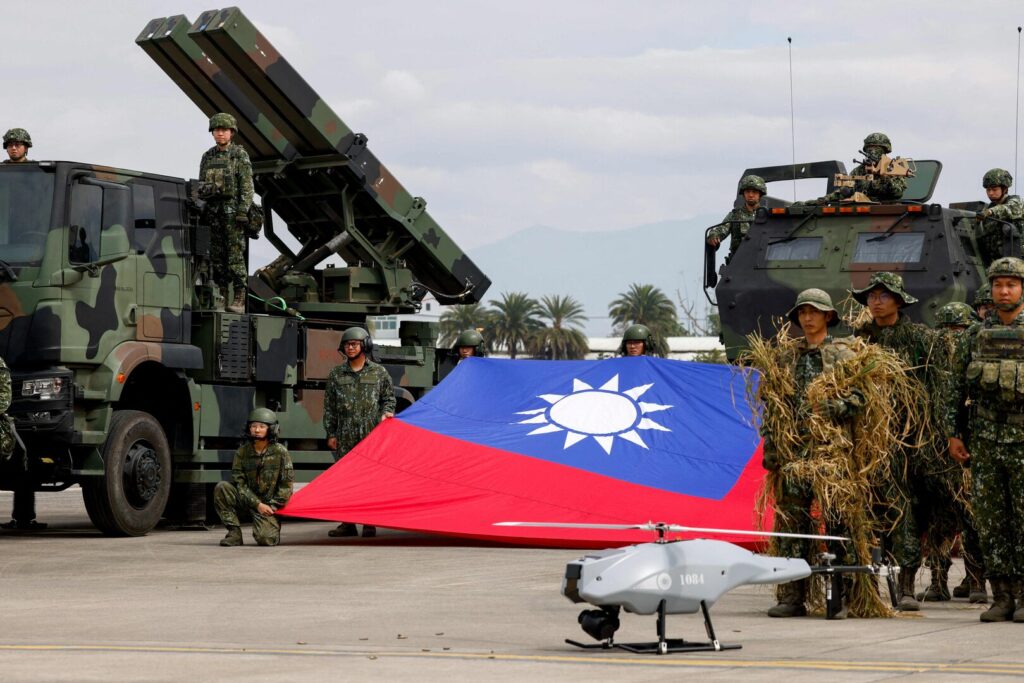
FILE PHOTO: Taiwanese soldiers pose with a Taiwanese flag near a Sky Sword II surface-to-air missile launcher and a military UAV during an annual military exercise ahead of Lunar New Year in Taichung, Taiwan, January 27, 2026. REUTERS/Ann Wang/File Photo
Taiwan is increasingly anxious over a recent delay by the United States in processing a $14 billion arms package meant to bolster its defense capabilities. This pause has raised alarm bells in Taipei, as officials and defense analysts worry that the halt could significantly weaken Taiwan’s military readiness and undermine confidence in the reliability of U.S. support amid escalating regional tensions.
The arms package, which includes advanced weaponry and critical defense systems, was intended to strengthen Taiwan’s ability to deter potential aggression, particularly from China. China views Taiwan as a breakaway province and has intensified military pressure in the region, making international backing, especially from the U.S., a crucial element of Taiwan’s defense strategy.
The delay comes at a time when Taiwan has been actively seeking to modernize its defense infrastructure in response to a growing threat environment. The country’s leaders fear that any pause in arms deliveries might embolden adversaries and send mixed messages about the steadfastness of U.S. commitments under longstanding defense alliances.
A U.S. pause on such a significant arms deal could be interpreted by Beijing as a window of opportunity to increase military activities near Taiwan, like incursions into its air defense identification zones or naval maneuvers in adjacent waters. Experts suggest that the delay risks altering the strategic calculus in the region, potentially destabilizing the current balance of power.
The embattled package includes a variety of hardware, from missile defense systems to advanced fighter jets, all crucial for Taiwan’s layered defense approach. Defense officials in Taipei argue that receiving these systems promptly is vital not only for national security but also for maintaining the morale of both the military and the population.
From Washington’s perspective, the reasons behind the delay remain unclear, though some speculate it may be related to ongoing diplomatic negotiations, budgetary reviews, or broader geopolitical considerations. However, the US administration has reassured its commitment to Taiwan’s security, reiterating that it remains a vital partner in ensuring peace and stability in the Indo-Pacific region.
Taiwan’s government has publicly expressed disappointment and concern over the postponement but continues to seek dialogue with U.S. officials to expedite the process. Analysts emphasize the importance of timely arms transfers to signal continued support and deter adversarial aggression.
The situation underscores the delicate balance the U.S. must maintain between supporting Taiwan and managing diplomatic relations with China, which vehemently opposes any foreign military assistance to the island.
As tensions in the Taiwan Strait continue to simmer, the delay in the arms package serves as a stark reminder of the complex geopolitical dynamics at play. For Taiwan, maintaining robust defense capabilities and strong international backing is imperative to safeguarding its sovereignty and democratic way of life.
In conclusion, the US arms delay has rattled Taiwan not only due to the tangible military implications but also because it casts doubt on the reliability of Washington’s support amid a volatile security environment. The coming weeks will be critical in determining how quickly the issue can be resolved and what it means for the future stability of the region.