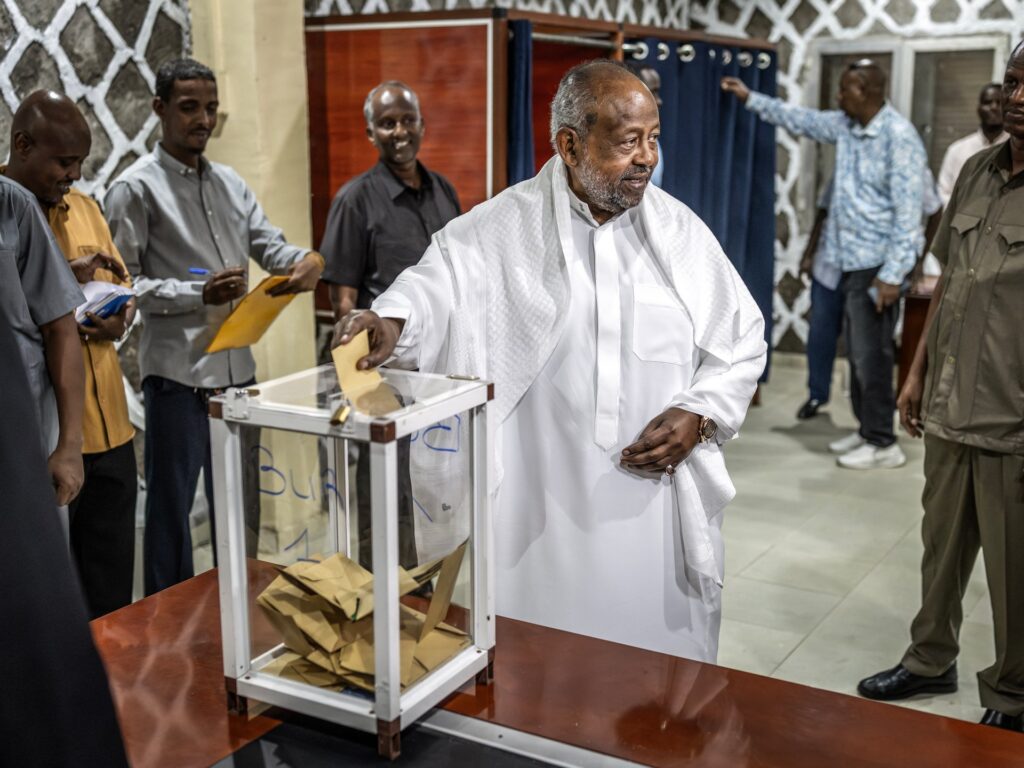
Djibouti’s President Ismaïl Omar Guelleh has won a historic sixth consecutive term in office, according to official election results. The longtime ruler, who has been in power since 1999, secured an overwhelming 97 percent of the vote, reaffirming his strong hold over the East African nation.
President Guelleh first came to the helm in 1999, succeeding his uncle, Hassan Gouled Aptidon, the country’s inaugural president. Since then, he has maintained a firm grip on Djibouti’s political landscape, overseeing significant development and positioning the country strategically in the Horn of Africa region.
The 2024 election saw a continuation of Guelleh’s dominance, with opposition candidates failing to pose a significant challenge. Critics argue that the electoral process has lacked competitiveness and questioned the fairness of the vote, pointing to Djibouti’s restricted political space and tight control over media and civil society.
Despite these concerns, supporters laud President Guelleh for providing political stability and economic growth. Under his leadership, Djibouti has become a vital hub for regional trade and military cooperation, hosting bases from several global powers due to its strategic location adjacent to the Red Sea and the Gulf of Aden.
The newly secured term reaffirms Guelleh’s entrenched position, extending his leadership into what will be nearly a quarter of a century. His government has invested heavily in infrastructure projects, including port expansions, transportation networks, and telecommunications, aimed at transforming Djibouti into a gateway to Africa.
International observers maintain a cautious stance, calling for greater transparency and democratic reforms to bolster the legitimacy of future elections. Meanwhile, the general populace exhibits mixed reactions, with many appreciating the economic progress but desiring more political freedoms and representation.
Djibouti’s election outcome underscores the enduring legacy of President Guelleh’s administration amid calls for democratic evolution. As he embarks on his latest term, the world watches closely how this small but geopolitically significant nation will navigate its future challenges and opportunities under long-standing leadership.