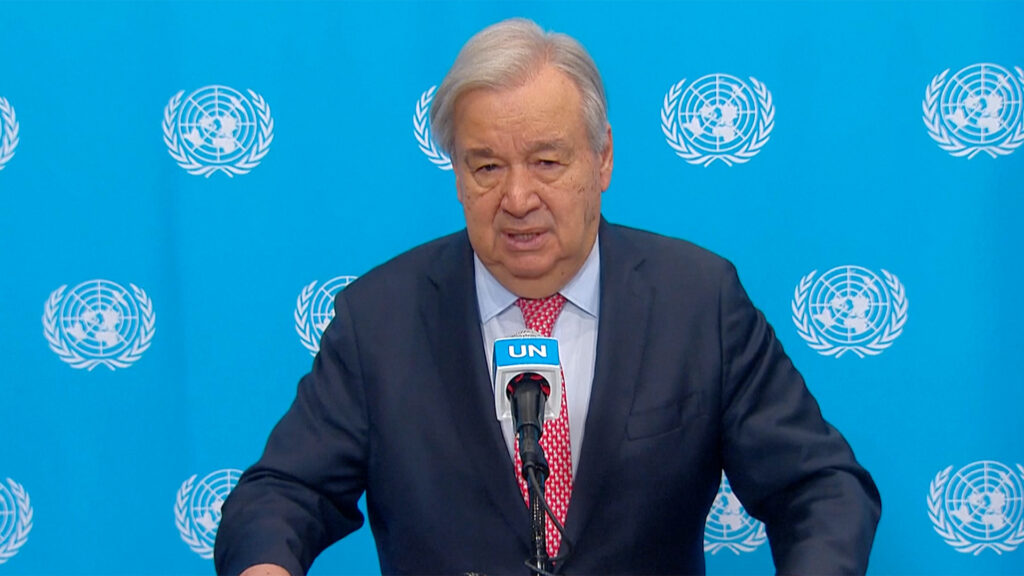
United Nations Secretary-General Antonio Guterres has issued an urgent call to end the escalating conflict in the Middle East, describing the current war involving Iran as “out of control.” His statement underlines the increasing instability in the region and the dire need for international intervention to prevent further deterioration.
Guterres emphasized that the violence and hostilities have exceeded manageable levels, threatening not only the involved nations but the global community as a whole. The conflict’s expansion has led to severe humanitarian crises, including widespread casualties, displacement of civilians, and disruptions to essential services.
The Secretary-General’s remarks come amid rising tensions that have alarmed many world leaders and prompted calls for dialogue and peace negotiations. The conflict’s complexity involves various national and regional interests making resolution particularly challenging.
Highlighting the urgent need for ceasefire and diplomacy, Guterres appealed to all parties to commit to peaceful discussions and halt military actions immediately. He stressed the UN’s readiness to facilitate talks and support conflict resolution efforts.
The recent escalation has seen intensified military operations attributed to the war, exacerbating regional insecurity and fueling fears of wider conflagration. International organizations have expressed concern about the repercussions on global peace and economic stability.
The UN Secretary-General’s plea aims to mobilize international actors and encourage coordinated efforts to bring about a sustainable peace, protect civilians, and address the root causes of the conflict.
Guterres called on Iran and other stakeholders to exercise restraint, engage constructively in diplomatic processes, and prioritize human lives over territorial or political gains.
The UN’s position underlines its commitment to upholding international law and the principles of sovereignty, territorial integrity, and peaceful coexistence.
This conflict, described as “out of control,” serves as a stark reminder of the costs of unresolved geopolitical tensions and the urgent need for global leadership in conflict resolution and peacebuilding initiatives.
As the situation develops, the UN continues to monitor the region closely, urging the international community to unite in efforts to end the violence and promote a durable peace framework for the Middle East.
In summary, the UN Chief’s declaration marks a critical moment for renewed focus on diplomacy and humanitarian support to alleviate the suffering caused by the ongoing war and prevent further escalation that could have catastrophic consequences beyond the region.