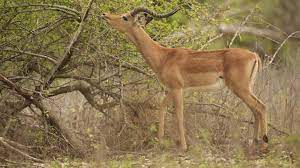
In a remote southeastern corner of Zimbabwe, people watched from cars or towers in an annual wildlife census, peering through binoculars at animals coming to drink at waterholes and jotting down notes, often by torchlight.
Around 140 volunteers slept in shifts through the 24-hour exercise, which is a valuable indicator of the status of the southern African nation’s wildlife resources during a worrying regional drought.
Before dawn, an elephant guided a calf to a stream. Lions roared in the distance. Noisy baboons stopped to drink. To everyone’s relief, the rains had come and the grasslands were looking green again in Gonarezhou National Park, whose name means “place of elephants.”
But keen eyes can pick out signs of trouble. The split and shattered trunks of the massive baobab trees and the damage to the umbrella-like acacia trees, the savanna’s shade providers, are evidence of desperate elephants searching for food and water in the 5,000-square-kilometer (1,900-square-mile) park.
In other reserves in wildlife-rich Zimbabwe, animals have suffered even more as climate change-induced drought conditions take their toll.
“It’s normal for animals to die, but now they are dying young,” he said. “They starve, they die. They get stuck in the mud desperately looking for water and they die. It’s heartbreaking.”
Farawo said the parks agency was still compiling statistics, but 15 elephants died in a week in Hwange, the country’s largest park, this month, with 16 buffaloes also found dead.
The dry spells are becoming longer and more severe. For decades, Zimbabwe’s rainy season ran reliably from October to March. It has become erratic in recent years, sometimes starting only in December.
“Climate change is turning out to be our biggest challenge,” Farawo said. “Weather patterns have become unpredictable, so animals often have no food and water. Right now we are in November and most of the country still has no rains.”
Across Africa’s national parks, similar effects of climate change are felt. Multiple studies show that extreme weather events are leading to the loss of plants and animals, which struggle to cope with longer dry spells and hotter temperatures.
Zimbabwe’s parks agency has intervened to ease the problem with 100 solar-powered boreholes to pump underground water into pools for animals to drink. But with so much surface water drying up, animals are still forced to walk longer distances, sometimes across national borders, in search of food and water.
The Kavango–Zambezi Transfrontier Conservation Area is the world’s largest multi-country conservation area, spanning 520,000 square kilometers (200,000 square miles) over five southern African countries including Zimbabwe. The area is larger than Germany and Austria combined and provides a corridor for animals to freely trek for hundreds of kilometers.
Many are taking that option, Farawo said.
“We often joke that unlike humans who stay close to the parks, animals can eat breakfast in Zimbabwe, lunch in Botswana and supper in another country,” he said.
The parched environment affects animals like elephants in multiple ways, according to a recent study by researchers from Zimbabwe, Britain and South Africa.
Their report, published in late October in the journal Nature Communications, cited a combination of heat, drought and population density as likely contributing factors for an outbreak of a blood-poisoning bacterial infection that killed 35 elephants during the dry season in Hwange National Park in western Zimbabwe in 2020. The report followed extensive tests on carcasses.
Zimbabwe is home to about 100,000 savanna elephants, second only to Botswana’s 130,000. Zimbabwe and Botswana over the decades have built large herds of elephants that far exceed the capacity of some parks, and both countries now say the effects of that overpopulation are worsened by resource depletion caused by climate change.
Birds are another victim. They need baobab, acacia and other trees for breeding, but hungry herbivores like elephants and giraffes leave little behind.
“They can only breed at a certain tree height, and it means it affects their breeding cycle because the trees are now too low for the security of their young ones,” Farawo said.
He warned that the future of some tree species is at risk, and “you can hardly see a young acacia or baobab tree because they are destroyed by the animals.”
And across Zimbabwe, there is increased conflict between humans and animals.
Many people living close to national parks, forests or mountains were already struggling to put food on the table due to depressed economic conditions. With the drought, they clash more frequently with animals that are encroaching into human settlements in search of food and water.
Farawo said the parks agency received about 4,000 distress calls from communities battling hyenas, lions, elephants and baboons in 2022, and the human-animal conflict has been rising over the last five years. The agency received 900 calls in 2018, he said.
People sometimes dig trenches, establish bee hives or bang pots and pans to keep away animals. They are not always successful.
In Hwange town and surrounding areas, residents have raised the alarm with parks authorities over herds of elephants venturing from the park to eat from people’s gardens and fields, even destroying water pipes so that they can drink.
In the eastern Manicaland province, residents described what they called a new phenomenon: A hyena killed a man, ripping off his lips and a limb. “Now they are turning to humans,” the state-run Manica Post newspaper quoted a resident as saying.
Farawo confirmed the incident.
“It’s because the animals are looking for food,” he said. “Hyenas are an indicator species of food availability. If there is no food, they move all over looking.”
___
Mutsaka reported from Harare, Zimbabwe.