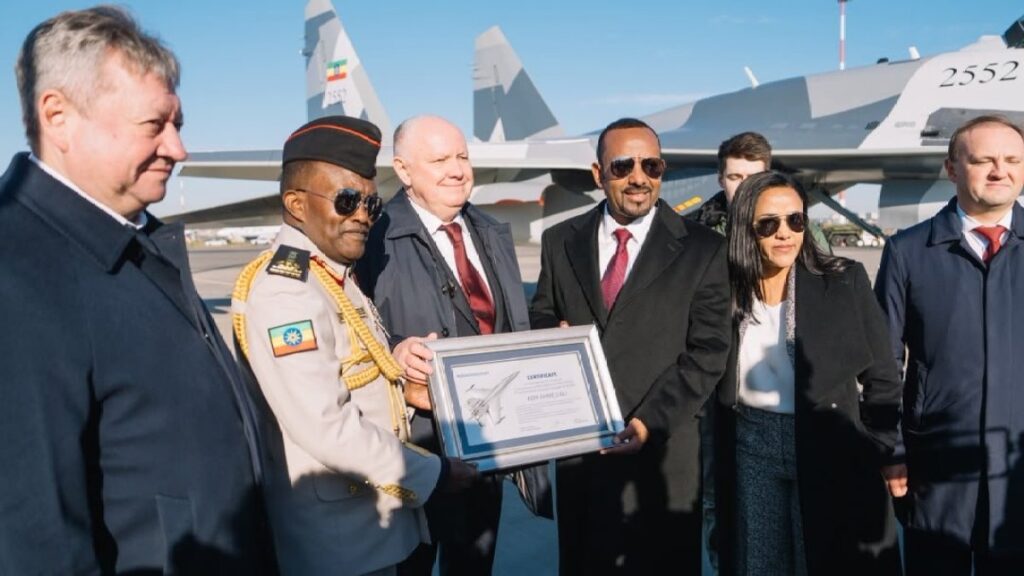
In a significant military development, Ethiopia has received 12 advanced Russian Su-35 fighter jets, signaling a notable boost to the country’s air defense capabilities. The announcement was made by Ethiopian Prime Minister Abiy Ahmed during a summit held in Moscow, highlighting the growing defense ties between Ethiopia and Russia.
The Su-35 is a highly maneuverable multi-role fighter jet equipped with state-of-the-art avionics and weaponry. Its acquisition is expected to enhance Ethiopia’s ability to secure its airspace and bolster its efforts against ongoing armed conflicts within its borders, particularly in the Tigray and Amhara regions. These regions have been the scenes of intense fighting against various armed groups, posing a severe challenge to national stability.
Alongside the receipt of the Su-35 jets, Prime Minister Abiy Ahmed also revealed plans to acquire the Russian S-400 missile defense system, a sophisticated surface-to-air missile platform known for its long-range and high-precision capabilities. The S-400 is regarded as one of the world’s most advanced air defense systems and would provide Ethiopia with enhanced protection against aerial threats.
The acquisition of such advanced military equipment underscores Ethiopia’s strategic move to strengthen its defense capabilities amidst an escalating security environment. The ongoing conflicts in the northern regions have seen significant humanitarian impacts, with numerous casualties and displacement of civilians. The government’s efforts to stabilize the situation have drawn international attention and calls for resolution through dialogue.
Russia’s role in supplying military hardware to Ethiopia reflects a deepening bilateral relationship centered around defense cooperation. This partnership comes at a time when Ethiopia seeks to diversify its military procurement sources amid complex geopolitical dynamics in the Horn of Africa.
Analysts note that the introduction of the Su-35 jets and potential acquisition of the S-400 systems may shift the military balance in the region. Ethiopia’s neighbors are closely monitoring these developments, given the potential implications for regional security and power dynamics.
Prime Minister Abiy’s announcement in Moscow followed high-level talks aimed at strengthening economic and military ties between the two countries. Ethiopia’s leadership views the enhanced military capabilities as a crucial component in maintaining sovereignty and quelling armed insurgencies threatening national unity.
The Ethiopian government has emphasized that the procurement of these advanced jets and missile systems is a defensive measure intended to protect its people and uphold peace and security within the country. As Ethiopia navigates the challenges posed by internal conflicts and complex regional relations, its military modernization drive is expected to continue.
The international community remains watchful of Ethiopia’s moves to ensure they contribute to a broader strategy of peace and stability. Meanwhile, Ethiopia’s military upgrades signal a firm resolve to address its security concerns through enhanced defense readiness and international partnerships.