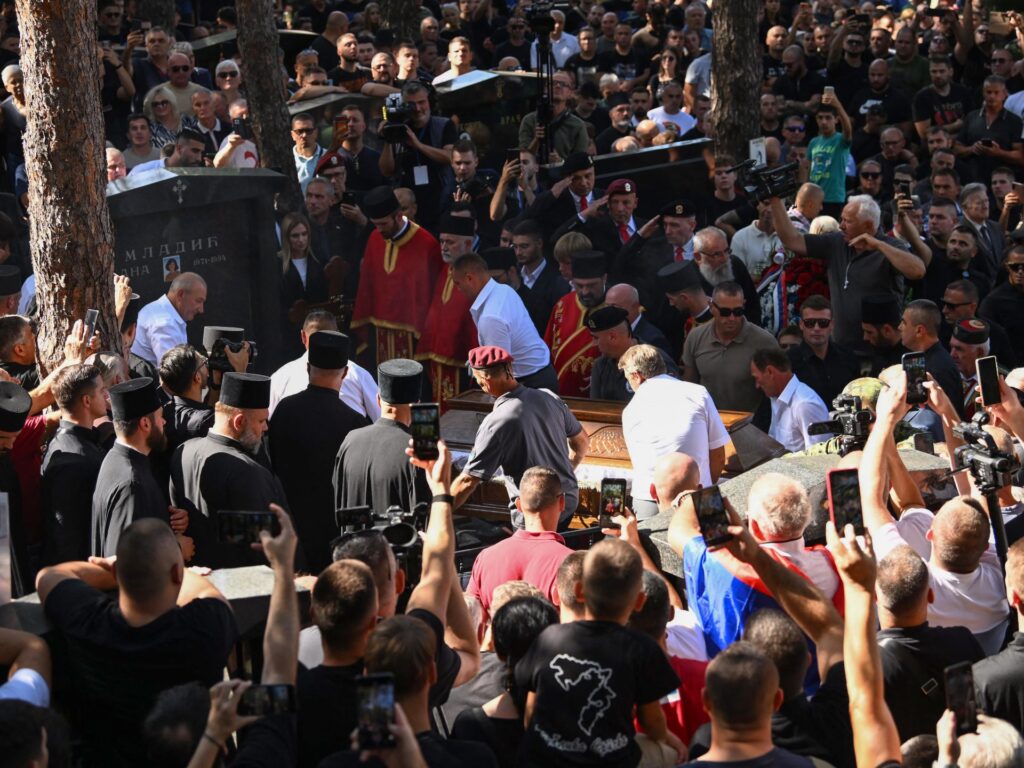
The European Union has sharply condemned the attendance of Serbian government ministers at the funeral of Ratko Mladic, a convicted war criminal responsible for some of the worst atrocities during the Balkan conflicts of the 1990s. EU leaders criticized this act as a significant setback in Serbia’s efforts to come to terms with its past and its commitment to justice and reconciliation.
Ratko Mladic, often referred to as the ‘Butcher of Bosnia,’ was a Bosnian Serb military leader found guilty of genocide, war crimes, and crimes against humanity, notably for his role in the Srebrenica massacre. His funeral, held in Serbia, drew attention not only for the somber occasion but also for the presence of high-ranking officials from the Serbian government.
The EU’s condemnation centers on the symbolic message sent by government ministers attending the funeral, which is seen as an implicit glorification of a figure convicted for grave atrocities. EU officials argue this undermines the decades-long process of reconciliation in the Balkans and Serbia’s aspirations to join the EU.
In a formal statement, EU representatives highlighted that confronting past war crimes openly is crucial for regional stability and for Serbia’s integration into European institutions. The presence of officials at the funeral is viewed as a failure to adequately address the painful legacy of the conflicts and to demonstrate respect for victims and survivors.
This incident has sparked public debate within Serbia and across the EU about the challenges in dealing with the war legacy. Many observers note that while Serbia has made progress in cooperating with international judicial bodies, there remains a faction within the country reluctant to acknowledge fully the crimes committed.
Human rights organizations have echoed the EU’s criticism, underscoring the importance of official condemnation of war crimes and the need for continued efforts to educate and reconcile divided communities. The funeral attendance by ministers is seen as contradictory to these goals.
Experts warn that such actions risk emboldening nationalist sentiments and could hamper the peace process in the Balkans. The EU continues to call on Serbian authorities to reaffirm their commitment to EU values, including respect for human rights, the rule of law, and accountability for past abuses.
As Serbia moves forward with its EU accession process, adherence to these principles remains a key criterion. The recent events surrounding Mladic’s funeral have thus raised serious concerns about the country’s readiness to embrace a future within the European community based on mutual respect and acknowledgment of history.
In summary, the EU’s condemnation of Serbian ministers attending Ratko Mladic’s funeral highlights the ongoing struggle in addressing war crimes legacies. It underscores the necessity for political leaders to demonstrate moral responsibility and for societies to seek reconciliation through honest reflection rather than revisionism or glorification of convicted war criminals.