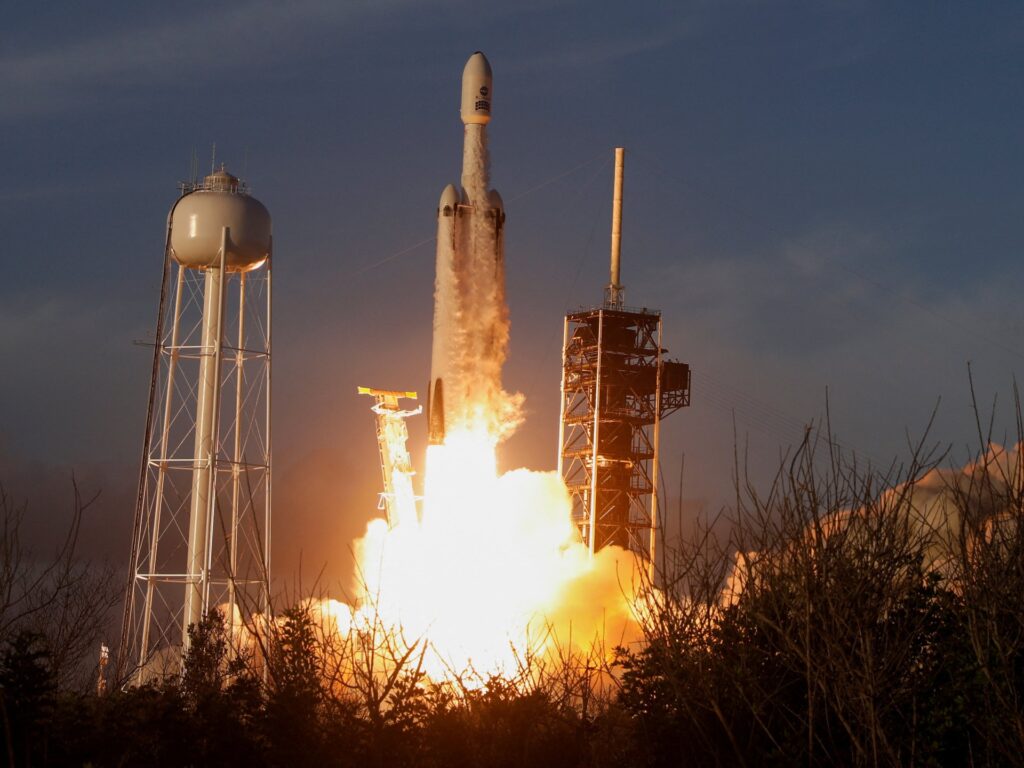
NASA has officially launched its highly anticipated Nancy Grace Roman Space Telescope, a monumental $4.3 billion mission designed to unlock some of the universe’s deepest mysteries. Propelled by the formidable SpaceX Falcon Heavy rocket, this telescope embarks on a pioneering journey to investigate dark energy and dark matter, phenomena that remain largely enigmatic yet constitute most of the cosmos.
Named in honor of Nancy Grace Roman, NASA’s first Chief Astronomer and a trailblazer in space telescope science, the Roman Telescope represents a significant leap forward in astrophysical research. Positioned to succeed the legacy of the Hubble Space Telescope, it boasts advanced technology that enables comprehensive surveys of the cosmos with unprecedented speed and detail.
The primary mission of the Roman Telescope is to shed light on dark energy, the mysterious force accelerating the expansion of the universe, and dark matter, the elusive substance accounting for a substantial portion of the universe’s mass. Understanding these components is vital as they influence the fate and evolution of the cosmos.
Equipped with a wide field of view and cutting-edge instruments, the telescope can map vast regions of space far more efficiently than previous observatories. Its innovative design allows it to capture high-resolution images of billions of galaxies and detect faint signals from distant celestial bodies that were previously beyond reach.
The launch aboard SpaceX’s Falcon Heavy—one of the most powerful rockets in operation—marks a new era of public-private partnerships in space exploration. This collaboration combines NASA’s scientific expertise with SpaceX’s engineering prowess to ensure the telescope reaches its orbital destination successfully.
Over the next several years, the Roman Telescope will perform wide-field imaging and spectroscopic surveys, providing critical data that could revolutionize our understanding of the dark components driving cosmic dynamics. Through this mission, scientists hope to answer fundamental questions about the structure and history of the universe, contributing to the broader quest for knowledge about our cosmic origins.
The telescope’s capabilities also extend to discovering exoplanets and studying their atmospheres, potentially identifying worlds that could harbor life beyond Earth. This adds an exciting dimension to its scientific portfolio, promising breakthroughs across multiple fields of astronomy and astrophysics.
By mapping the distribution and properties of dark energy and dark matter, the Roman Telescope will inform theoretical models and guide future space missions. Its findings are expected to complement data from other observatories, including the James Webb Space Telescope and ground-based facilities worldwide.
The successful deployment and operation of the Roman Telescope underscore the advances in technology and international cooperation critical for modern space science. As the telescope begins its cosmic survey, it invites humanity to look deeper into the universe and uncover secrets that have shaped its evolution and our place within it.
In summary, the launch of NASA’s Roman Space Telescope heralds a transformative era in astronomical observation. With its sophisticated instruments powered into orbit by the SpaceX Falcon Heavy, this mission aims to unravel the mysteries of dark energy and dark matter while expanding the horizons of discovery in our vast universe.