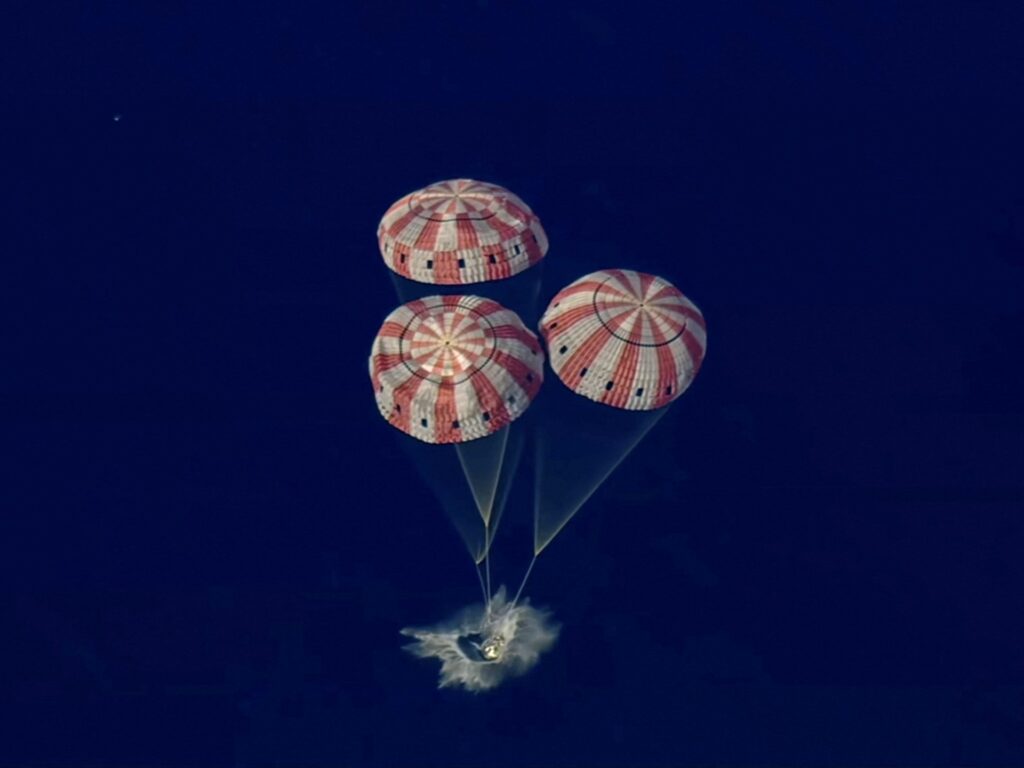
The Artemis II mission marked a monumental achievement in space exploration as the crew successfully returned to Earth, splashing down in the Pacific Ocean. This mission, a critical step following the pioneering Artemis I, involved a high-speed re-entry into Earth’s atmosphere, designed to rigorously test the spacecraft’s heat shield under extreme conditions.
After orbiting the Moon and completing their mission objectives, the Artemis II astronauts experienced a high-velocity return to Earth, emphasizing the robustness and reliability of the new generation of space capsules. The splashdown, accompanied by parachutes deploying perfectly, signified the safe conclusion of their journey.
The heat shield, a crucial component designed to protect the crew from the extreme temperatures generated during re-entry, performed flawlessly. This test was vital, as it ensures the safety of future crews on longer and more complex missions, potentially including manned Mars missions.
The Pacific Ocean was chosen as the landing site due to its vast expanse, providing a safe and controlled environment for the recovery operations. Recovery teams were on standby to retrieve the crew and spacecraft promptly, ensuring the astronauts’ quick return to land and medical evaluation.
Artemis II’s success is a testament to the advancements in aerospace technology and international cooperation in space exploration. The mission builds on the legacy of the Apollo missions, aiming to establish a sustainable human presence on the Moon and beyond.
During the mission, the crew conducted various scientific experiments and tests to gather data, which will inform future lunar missions and help refine technologies for deep space travel. The data collected also enhances our understanding of the space environment and the impacts of space travel on human physiology.
The mission’s successful completion has energized the space community and inspired the public, reinforcing the importance of continued investment in space exploration. Organizations worldwide are closely watching the developments of the Artemis program as humanity steps closer to its goal of becoming a multi-planetary species.
As Artemis II’s astronauts safely touched down, the spotlight now shifts to the next phases of lunar exploration, including the planning and execution of subsequent Artemis missions. These will push the boundaries of human capabilities in space and aim to establish a lunar base camp, serving as a hub for scientific research and a stepping stone for deep space exploration.
In summary, the Artemis II splashing down in the Pacific Ocean is not just a return to Earth but a giant leap forward in humanity’s quest to explore the cosmos. The mission demonstrated the ingenuity, courage, and pioneering spirit of current and future generations of astronauts and space enthusiasts.
The world eagerly anticipates the upcoming chapters of the Artemis program, which promises to deliver new discoveries, technological breakthroughs, and inspire generations to look up and reach for the stars.