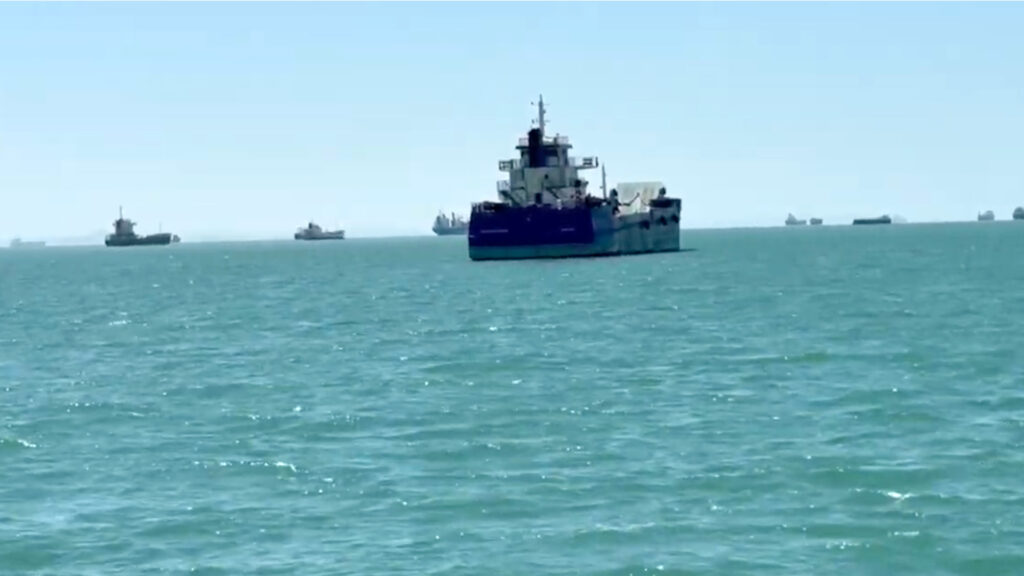
In a recent development that highlights growing maritime concerns, a Canadian YouTuber and activist has captured striking imagery showing a dense cluster of dozens of oil tankers and cargo ships congesting the Hormuz Strait. This vital waterway is one of the world’s most strategically significant maritime passages, linking the Persian Gulf with the Gulf of Oman and the Arabian Sea, and is crucial for global oil transportation.
The footage, obtained by the Canadian activist through aerial or on-site recording methods, illustrates the scale of maritime traffic in this narrow strait. The Hormuz Strait is notorious for its busy shipping lanes, given that an estimated 20% of the world’s petroleum passes through it daily. The congestion caught on camera accentuates both logistical challenges and geopolitical tensions that can arise in such a critical chokepoint.
Experts explain that the accumulation of vessels occurs due to several factors including security checks, regional political dynamics, weather conditions, and increased shipping demands. The heightened traffic congestion not only raises concerns about delays in the shipment of essential commodities like oil but also increases the risk of accidents and environmental hazards.
The Canadian YouTuber’s documentation sheds light on an often-overlooked aspect of international trade—the physical constraints and risks that come with maritime shipping routes. The videos serve as a reminder of how global supply chains rely heavily on the uninterrupted flow of ships through narrow maritime corridors.
This congestion happens amid ongoing regional tensions in the Middle East, with various countries vying for influence and control over resources and trade routes. The Hormuz Strait has historically been a hotspot for incidents related to political disputes and military confrontations, making the situation an important area of focus for international security analysts.
The images and videos shared by the activist have caught the attention of maritime authorities and geopolitical experts worldwide. There is growing international concern about the potential impact of such congestion on global oil prices, trade stability, and regional security.
Moreover, the Canadian YouTuber’s efforts underscore the power of social media and independent activism in raising awareness about complex geopolitical issues. By documenting the reality on the ground—or in this case, the sea—they provide crucial insights that might otherwise be obscured or underreported.
In conclusion, the congestion of dozens of oil tankers and cargo ships in the Hormuz Strait, as captured by the Canadian YouTuber, highlights significant challenges in maritime logistics and security. It calls for attention from global policymakers, maritime authorities, and environmental agencies to monitor and manage traffic flow, ensure safety, and mitigate geopolitical risks in this essential global waterway.