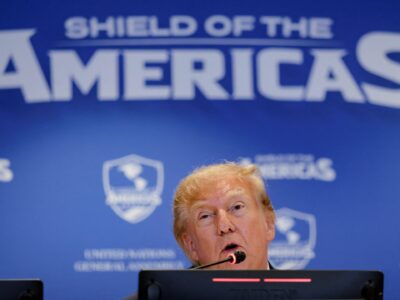
PALM BEACH, Fla. — President Donald Trump on Saturday signed an order to impose stiff tariffs on imports from Mexico, Canada and China, drawing swift retaliation from the country’s North American neighbors in an emerging trade war.
The Republican president posted on social media that the tariffs were necessary “to protect Americans,” pressing the three nations to do more to curb the manufacture and export of illicit fentanyl and for Canada and Mexico to reduce illegal immigration into the U.S. The action fulfilled one of Trump’s commitments to voters but threw the global economy and Trump’s own political mandate to lower prices into turmoil.
The tariffs, if sustained, could cause inflation to significantly worsen, possibly eroding voters’ trust that Trump could as promised lower the prices of groceries, gasoline, housing, autos and other goods.
Trump declared an economic emergency in order to place duties of 10% on all imports from China and 25% on imports from Mexico and Canada. But energy imported from Canada, including oil, natural gas and electricity, would be taxed at a 10% rate.
The action provoked an economic standoff with America’s two largest trading partners in Mexico and Canada, upending a decades-old trade relationship with the possibility of harsh reprisals by those two nations.
Mexico’s president immediately ordered retaliatory tariffs and Canada’s prime minister said the country would put matching 25% tariffs on up to $155 billion in U.S. imports. China did not immediately respond to Trump’s action.
Trump’s order includes a mechanism to escalate the rates charged by the U.S. against retaliation by the other countries, raising the specter of an even more severe economic disruption.
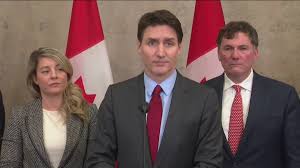
Canadian Prime Minister Justin Trudeau on Saturday said that Canadian duties on $30 billion in trade in American alcohol and fruit will take effect Tuesday, when the U.S. tariffs go into effect. He opened his address to Canadians with a message aimed at American consumers.
“It will have real consequences for you, the American people,” he said, saying it would result in higher prices on groceries and other goods.
Trudeau channeled the views of many Canadians who were feeling betrayed by their neighbor and longtime ally, reminding Americans that Canadian troops fought alongside them in Afghanistan and helped them respond to myriad crises from wildfires in California to Hurricane Katrina.
“The actions taken today by the White House split us apart instead of bringing us together,” Trudeau said, warning in French that it could bring about “dark times” for many people. He encouraged Canadians to “choose Canadian products and services rather than American ones.”
Mexican President Claudia Sheinbaum said she had instructed her economy secretary to implement a response that includes retaliatory tariffs and other measures in defense of Mexico’s interests.
“We categorically reject the White House’s slander that the Mexican government has alliances with criminal organizations, as well as any intention of meddling in our territory,” Sheinbaum wrote in a post on X.
“If the United States government and its agencies wanted to address the serious fentanyl consumption in their country, they could fight the sale of drugs on the streets of their major cities, which they don’t do and the laundering of money that this illegal activity generates that has done so much harm to its population.”
Meanwhile, the Premier of Canadian province of British Columbia, David Eby, called on residents to stop buying liquor from U.S. “red” states and said it was removing American alcohol brands from government store shelves as a response to the tariffs.
In a televised message, Eby deemed the Trump’s administration decision as “a declaration of economic war against a trusted ally and friend” and that he will stand up for his citizens and all Canadians in general.
“Effective today, I have directed B.C. liquor sales to immediately stop buying American liquor from red states,” he said. “Liquor store employees will be removing the most popular of these brands from government store shelves.”