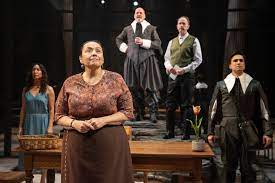
The financial crisis of 2008 hit Mary Kathryn Nagle differently. As a playwright and a citizen of the Cherokee Nation, she saw parallels to events that negatively impacted Indigenous people centuries ago.
Her play “Manahatta” juxtaposes the recent mortgage meltdown when thousands lost their homes to predatory lenders with the shady 17th-century Dutch who swindled and violently pushed Native Americans off their ancestral lands.
“A lot of times history does repeat itself,” Nagle says. “I’m really interested in the ways in which we can connect to our past, carry it with us, learn from it, and maybe change outcomes so that we’re not just doomed to repeat the past in the present.”
Nagle’s 2018 play has landed in New York City at the prestigious Public Theater this winter and it’s just the latest in a flowering of Native storytelling. From “Reservation Dogs,” “Dark Winds” and “Rutherford Falls” on TV to “Prey” on the big screen and Larissa FastHorse becoming the first Indigenous female playwright on Broadway, barriers are being broken.
“I hope it’s not a moment. I hope it’s the beginning of an era,” says FastHorse, a member of the Sicangu Lakota Nation and a 2020 MacArthur Fellow. “We stand on the shoulders of so many folks that came before us.”
“The truth was most theaters had never produced a single play by a Native playwright. Most Hollywood film studios had never produced any content actually written or produced by Natives. It may have been about some Native people, but it was not written by Native people. And we’ve just seen that flipped on its head,” Nagle said.
Non-Native storytellers are also exploring the history of white atrocities on Native Americans with Martin Scorsese’s “Killers of the Flower Moon” telling the story of the Reign of Terror in Oklahoma, and documentary-maker Ken Burns examining an animal central to the Great Plains with “The American Buffalo.”
Nagle recalls moving to New York in 2010 and asking artistic directors of theaters why they weren’t producing Native work. They would answer that they didn’t know any Native playwrights or that there weren’t enough Native audiences to power ticket sales.
“Good storytelling is good storytelling, whether the protagonist is white, Black, Asian, LGBTQ — it doesn’t matter,” said Nagle, who is on the board of IllumiNative, a nonprofit working to deal with the erasure of Native people.
“There’s a lot of projects out there that are changing the narrative and that are proving that our stories are powerful and that non-Natives are really moved by them because they’re good stories.”
Madeline Sayet, a playwright and professor at Arizona State University who also runs the Yale Indigenous Performing Arts Program, sees the contemporary Native theater movement flowing from the Civil Rights Movement of the ‘60s and ’70s and an increase in awareness of Indigenous issues ever since Native people won the right to legally practice their culture, art and religion.
She connects the Wounded Knee occupation of 1973 to the Standing Rock standoff over the Dakota Access Pipeline in 2016 to Ned Blackhawk’s “The Rediscovery of America: Native Peoples and the Unmaking of U.S History” winning the National Book Award this year.
Sayet, a member of the Mohegan Tribe who became the first Native playwright produced at the Public when her “Where We Belong” made it in 2020, said keeping Indigenous stories being produced depends on changing funding structures and getting long-term commitments from theaters and programs like Young Native Playwrights Contest.
“Part of what’s really helping right now is us all creating more opportunities for each other instead of in competition with each other,” she said.
FastHorse, who made history on Broadway in 2023 with her satirical comedy “The Thanksgiving Play,” which follows white liberals trying to devise a culturally sensitive Thanksgiving play, has since turned her attention to helping rewrite some classic stage musicals to be more culturally sensitive.
“Native people have been exotified in a way that keeps us othered and separate, sometimes in a negative way, as in, ‘We just kill all the Indians’ and sometimes in a ‘positive’ way where they’re this special, magical thing.”
She has recently reworked the book for an upcoming touring musical revival of the 1954 classic “Peter Pan,” which was adapted by Jerome Robbins and has a score by Moose Charlap-Carolyn Leigh and additional songs by Jule Styne, Betty Comden and Adolph Green.
FastHorse found the character of Peter Pan complex, the pirates funny, the music enchanting but the depictions of Indigenous people and women appalling. There were references to “redskins” throughout, a nonsense song called “Ugh-A-Wug” and Tiger Lily fends off randy braves “with a hatchet.”
“I was like, ‘What? We’re having little kids read this? This is just rape culture written out, exoticized with a Native person to boot,” she said. “This is what makes you a good woman? If you fight hard enough to keep the men away?”
FastHorse widened the concept of Native in the musical to encompass members of several under-pressure Indigenous cultures from all over the globe — Africa, Japan and Eastern Europe, among them — who have retreated to Neverland to preserve their culture until they can find a way back.
The playwright said one of her guiding principles in the reworking was to make sure a little Native girl in South Dakota could see herself and celebrate. “Then we’ve done our job and she can join the magic instead of having to armor herself against the magic.”
Nagle is enjoying making her debut at the Public Theater — her play runs through Dec. 23 — but is realistic that no one play is going to teach everyone every single lesson they need to know about Native people after hundreds of years of misinformation.
“I think one thing I’m just hoping that people take away from this play is like, ‘Wow, Native stories are really compelling. Native people are incredible. They’re incredibly resilient. They’re incredibly brilliant. Yes, there’s tragedy, but they have such incredible senses of humor,’” she said.
“I want them to love my characters the way I love them. I want them to feel the heartache. I want them to feel the laughter. I want them to feel the love,” she said. “And I want them to leave the theater just wanting to know more about our tribal nations and our Native people.”