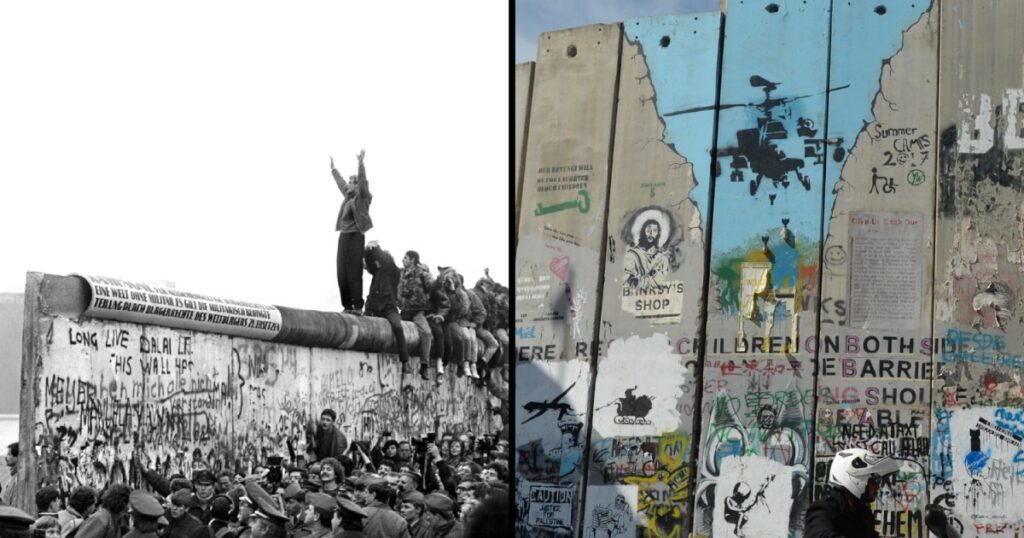
The Israeli separation wall in the occupied West Bank stands as a potent symbol of division, bearing significant comparisons to one of the 20th century’s most infamous barriers—the Berlin Wall. Both structures have played pivotal roles in physically and socially dividing communities, shaping the lives of those on either side.
Constructed with a primary stated aim of enhancing security and preventing attacks, Israel’s separation wall extends over hundreds of kilometers, slicing through Palestinian territory. Unlike the Berlin Wall, which rigidly demarcated East and West Berlin during Cold War tensions, the Israeli wall’s route is often perceived as more complex and erratic, frequently deviating from the 1949 armistice line (the Green Line), effectively annexing Palestinian land.
The wall comprises concrete slabs, fences, and barbed wire, punctuated by a network of military checkpoints. These checkpoints, coupled with a stringent permit regime, regulate Palestinian movement, fragmenting communities and severely restricting access to vital resources, employment, and social services. The impact on daily life is profound, as farmers, for example, find themselves cut off from their own land, disrupting agricultural activity and livelihoods.
Palestinian residents face a labyrinthine permit system that governs access not only to their farmland but also to hospitals, schools, and workplaces. This system contrasts sharply with the Berlin Wall, which, while heavily fortified and patrolled, did not feature the same bureaucratic impositions on movement within East Germany but instead served as a barrier against defection to the West.
The separation wall has led to deep socio-economic ramifications in the West Bank. It has isolated villages and neighborhoods and created “enclaves” surrounded by Israeli-controlled territory. These conditions have compounded economic hardship and fueled tensions.
Internationally, the construction and expansion of the separation wall have drawn widespread condemnation. The International Court of Justice issued an advisory opinion in 2004 declaring the construction of the wall in occupied Palestinian territory contrary to international law. This stance contrasts with the Berlin Wall, which, while disputed and controversial internationally, was a recognized boundary for decades until German reunification.
Symbolically, both walls represent tangible markers of division. The Berlin Wall became a global icon of Cold War ideological conflict and repression, ultimately falling in 1989 to jubilant crowds heralding freedom. The Israeli wall elicits mixed perceptions, viewed by some Israelis as vital for security and by many Palestinians as a tool of oppression and territorial fragmentation.
In essence, the Israeli separation wall differs from the Berlin Wall in purpose, construction, and the socio-political context surrounding it. While both walls physically separate populations and restrict movement, the Israeli wall’s impact resonates through its embeddedness in an ongoing territorial conflict involving disputed sovereignty and rights.
The enduring division imposed by Israel’s separation wall encapsulates complex dynamics of control, contestation, and survival in the West Bank. Farmers separated from their land, families divided, and communities partitioned illustrate a lived reality that extends beyond the mere physical structure, echoing the profound human cost similar yet distinct from the legacy left by the Berlin Wall.